
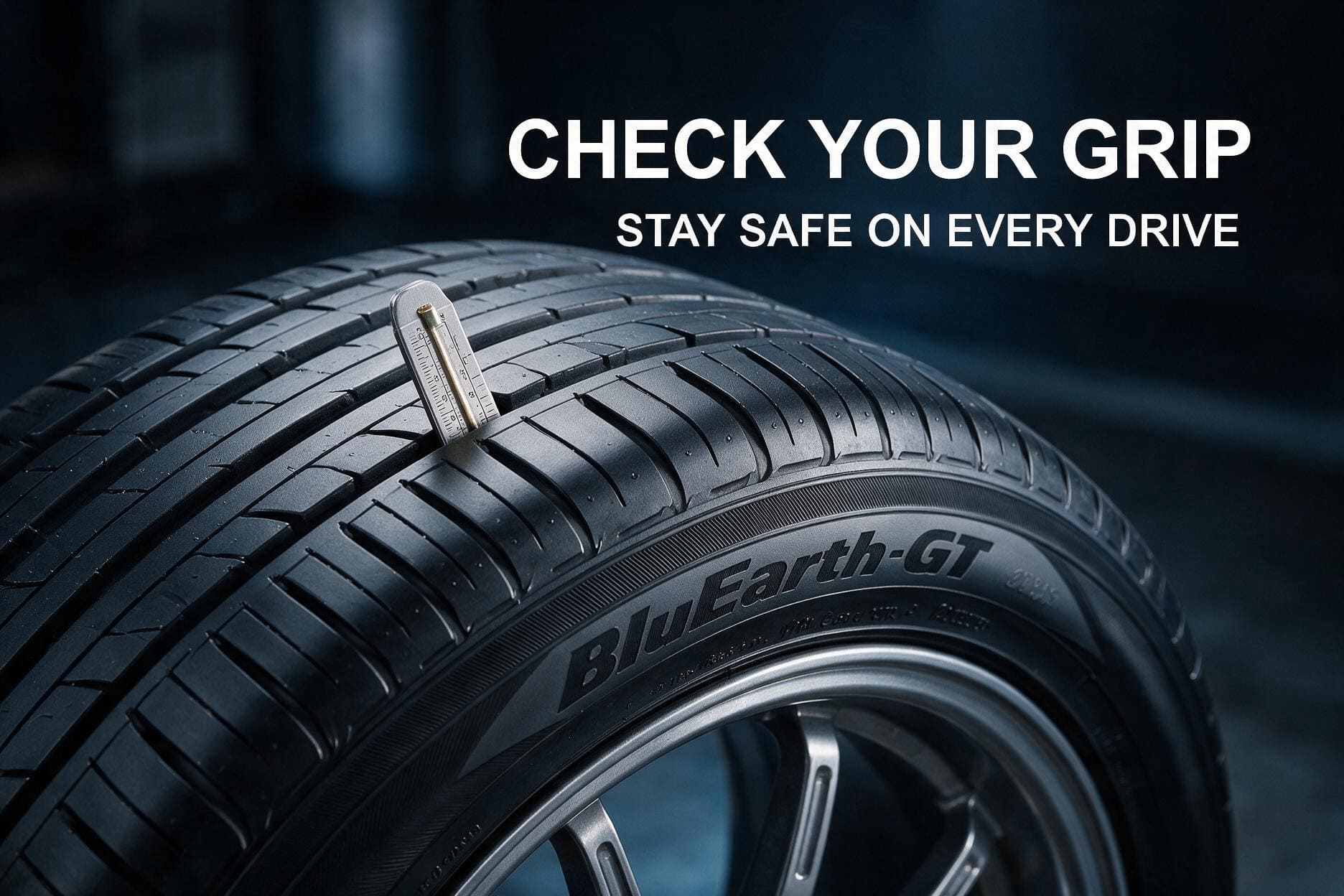
Tyre tread depth is the vertical measurement between the top of the tread rubber and the bottom of the tyre’s deepest grooves, usually expressed in millimetres. It tells you how much grip your tyres have left, and in Malaysia the law requires at least 1.6 mm before a tyre is considered unsafe and illegal to use.
That single number sits behind nearly every safety decision you make about your tyres. The grooves you measure are what channel water away on a wet road, bite into the surface when you brake, and keep the car pointed where you steer it. As the tread wears down, all of those abilities fade, which is why understanding tread depth matters far more than most drivers in Malaysia realise. This guide walks through the legal limit, how to measure tread accurately, why depth governs wet grip, and when it is time to fit new tyres.
What Is the Legal Minimum Tyre Tread Depth in Malaysia?
The legal minimum tyre tread depth in Malaysia is 1.6 mm across the main grooves of the tyre. This figure is the longstanding national standard, and it matches the limit used across many countries because below it a tyre’s ability to grip a wet road drops sharply. Once any part of the contact surface falls under 1.6 mm, the tyre is treated as worn out in the eyes of the law.
Enforcement of this rule has tightened recently. From 1 June 2025, the Road Transport Department (Jabatan Pengangkutan Jalan, or JPJ) began requiring all commercial vehicles to meet the 1.6 mm minimum across the entire tyre surface. The previous standard accepted compliance across only 75 percent of the tyre surface, so the change closes a loophole that allowed partially bald tyres to pass.
The practical consequence is straightforward. Any commercial vehicle that fails the tread depth check will not pass inspection at a Motor Vehicle Inspection Centre. For private car owners, the same 1.6 mm principle applies on the road, and driving on tyres below it exposes you to summonses and, more importantly, to a real loss of control in wet conditions.
How to Measure Tyre Tread Depth
Measuring tyre tread depth at home takes only a minute, and there are three reliable methods. Each one checks the same thing, which is how far the grooves have worn down toward the 1.6 mm danger line. Checking across several points on each tyre also reveals uneven wear that can signal alignment or pressure problems.
Using a Tread Depth Gauge
A tread depth gauge is the most precise tool for the job. The common design is a graduated probe with a thin retractable rod and a flat foot. You extend the rod, insert it into a main groove, then press the foot flat against the tread ribs until the marked shaft slides up to show the reading in millimetres. Take measurements in the inner, centre and outer grooves of each tyre, because the numbers often differ and the lowest one is what counts.
Reading the Wear Bars
Every modern tyre has its own built-in indicator, so you may not even need a tool. These treadwear indicators, also called wear bars, are small raised ridges moulded into the bottom of the grooves at the 1.6 mm level. When the surrounding tread wears down flush with these bars, the tyre has reached the limit and needs replacing. Crouch beside the tyre and look along a groove, and the bars are easy to spot once you know what they are.
The Coin Method
If you have neither a gauge nor good light on the wear bars, a coin gives a quick rough check. Slot a coin edge-on into a main groove and see how much of the rim or pattern the tread covers. The principle is the same one behind the coin test, where tread that fails to reach a fixed reference mark means you are running low and should measure properly. Treat this as a warning sign rather than an exact figure, then confirm with a gauge.
Why Tyre Tread Depth Matters for Wet Grip and Aquaplaning
Tread depth matters most the moment the road turns wet, which in Malaysia happens often and without much warning. The grooves in your tyre exist to give rainwater somewhere to go, scooping it out from under the contact patch so the rubber can still touch the road. Shallow tread cannot move water fast enough, and that is when grip disappears.
The clearest danger is aquaplaning, sometimes called hydroplaning. Aquaplaning happens when a tyre cannot channel water away quickly enough, so a wedge of water lifts the tyre off the surface and the car effectively skates on a film of liquid. When this occurs the steering goes light, braking does almost nothing, and the driver has very little control until the tyres regain contact. Deeper tread pushes that risk further away because it has more capacity to disperse water.
Wet braking distances tell the same story. Testing shows that wet braking distance can be up to 44 percent longer at the 1.6mm limit than at 3mm of tread, which can mean several extra car lengths before the car stops. Crucially, the loss of grip begins well before a tyre is legally worn, fading steadily over the final millimetres of tread.
When Should You Replace Your Tyres?
You should replace your tyres before they reach the 1.6 mm legal minimum, not at it. Reaching the legal line means your tyres are already operating with the least grip the law permits, so safety experts treat it as the absolute floor rather than a target. Building in a margin gives you back the wet weather performance that worn tread quietly takes away.
A widely recommended trigger point is 3 mm. Safety guidance suggests replacing tyres at around 3mm rather than waiting for the legal limit, precisely because wet grip falls off steeply over the last couple of millimetres. Following that advice in Malaysia, where heavy monsoon downpours are routine, gives you a comfortable safety buffer through the wettest months.
Tread is not the only thing to watch, either. Safety authorities advise checking tread at least once a month and replacing tyres once the tread sits level with the wear bars, alongside inspecting for cuts, bulges and uneven wear. Age and damage can retire a tyre even when some tread remains, so a monthly look matters. If you are unsure where your tyres stand, our guide on when to change your car tyres walks through the full set of warning signs, and you can use our checklist on whether you have checked your tread depth as a simple monthly reminder.
How Much Tread Does a New Tyre Have?
A new passenger car tyre starts life with roughly 8 mm of tread depth. A new car tyre begins with about 8mm, and some sport utility, light truck and specialist tyres carry even more. Knowing this starting figure helps you understand how much usable tread you actually have to work with over a tyre’s life.
The maths is sobering once you frame it this way. Of that 8 mm, only the depth above 1.6 mm is legal to use, and only the depth above roughly 3 mm delivers confident wet grip. In other words, a tyre spends much of its mileage in its strongest condition and then loses performance faster as it nears the end. Tracking the number from new helps you plan replacement before grip becomes a problem rather than after.
Choosing Tyres That Hold Their Grip Longer in Malaysia
Knowing your tread depth is only useful if the tyres you fit are built to deliver grip throughout their life, and this is where the brand on the sidewall counts. The quality of the rubber compound and tread design decides how well a tyre channels water and how evenly it wears over the years, so choosing a maker with deep engineering credentials protects the safety margin you have just learned to measure. For drivers in Malaysia, Yokohama brings exactly that pedigree.
Yokohama is an award-winning Japanese tyre brand established in 1917, and it was the first Japanese tyre maker to earn ISO 9001 certification for its quality management. That heritage runs through three distinct product lines built for different needs: the high-performance ADVAN range, the rugged GEOLANDAR line for SUVs and light trucks, and the fuel-efficient BluEarth family for everyday comfort and economy. Every Yokohama tyre is backed by the We Care Road Hazard Warranty and supported by authorised dealers nationwide, with Yokohama Tyre Sales Malaysia acting as the sole official importer.
So once your tread depth check tells you it is time for a fresh set, fit tyres engineered to keep that tread working harder for longer. Choose the award-winning Japanese engineering, the ISO 9001 quality assurance, the ADVAN, GEOLANDAR and BluEarth ranges, and the nationwide dealer network behind Yokohama.
Frequently Asked Questions
What is the minimum legal tyre tread depth in Malaysia?
The minimum legal tyre tread depth in Malaysia is 1.6 mm. Driving below this means your tyres are legally worn out, and JPJ now enforces the 1.6 mm limit across the entire tyre surface for commercial vehicles at inspection.
How can I check my tyre tread depth at home?
You can check tyre tread depth with a tread depth gauge for an exact reading, by looking at the moulded wear bars in the grooves, or by using a coin as a quick rough guide. The wear bars are the easiest method because they are built into every tyre at the 1.6 mm mark.
At what tread depth should I replace my tyres?
Many safety bodies advise replacing tyres at around 3 mm rather than waiting for the 1.6 mm legal limit, since wet grip drops sharply over the final millimetres of tread. In Malaysia’s wet climate, that earlier replacement point is a sensible safety margin.
Does low tread depth cause aquaplaning?
Yes. Shallow tread cannot clear water from under the tyre fast enough, and this is exactly what triggers aquaplaning. The deeper your tread, the more water the grooves can disperse and the lower your risk on flooded roads. For more on heavily worn rubber, see our guide to worn out tyres.
How much tread does a new tyre have?
A new passenger car tyre typically has around 8mm of tread depth, with some larger and specialist tyres carrying more.
Sources
- TyreSafe – The Complete Guide to Tyre Tread Depth
- RAC – Tyre Tread Depth, UK Law and Tyre Safety Checks
- National Highway Traffic Safety Administration – Tire Safety Ratings and Awareness, TireWise
- U.S. Tire Manufacturers Association – Tire Care & Safety
- Paul Tan’s Automotive News – Minimum 1.6 mm tread depth across entire tyre surface a must for all commercial vehicles, JPJ
- Yokohama Tyre Malaysia – Home