
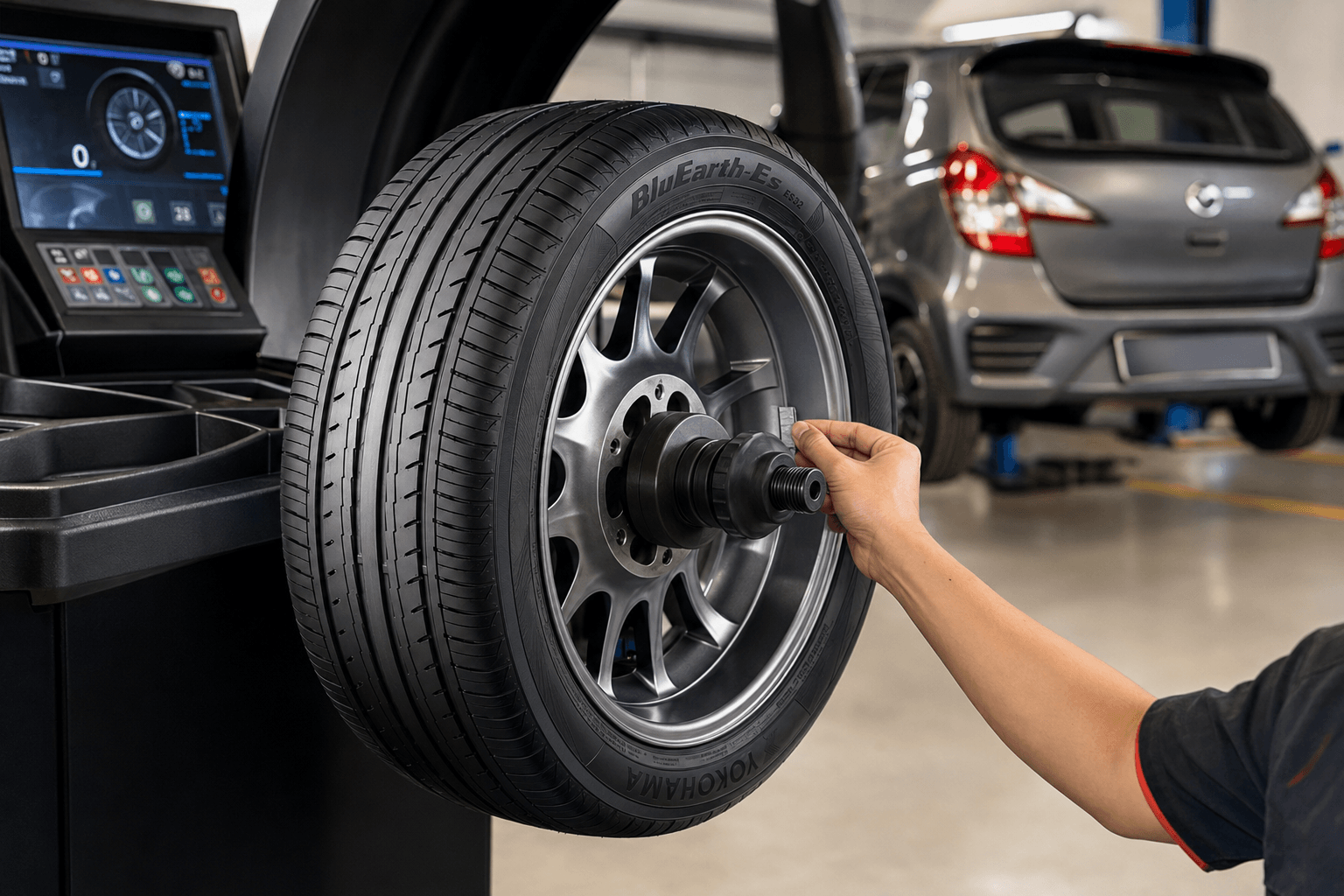
Tyre balancing is the process of evening out the weight distribution of a wheel and tyre assembly so it spins smoothly at every speed. It matters because even a tiny heavy spot, when spun at highway speeds, turns into the vibration you feel through the steering wheel, the floor, or the seat.
Most Malaysian drivers only think about their tyres when something feels wrong, yet balancing quietly protects ride comfort, tyre life, and safety every kilometre you drive. This guide explains what tyre balancing actually does, how the weights are fitted, the difference between static and dynamic methods, the warning signs to watch for, and how often the job should be done in Malaysia.
What Tyre Balancing Is and How Weights Are Added
Tyre balancing corrects uneven weight around a wheel and tyre assembly so the mass spins evenly about the axis of rotation. No tyre and rim combination is perfectly uniform, and the small differences left over from manufacturing create heavy spots that throw the wheel off as it turns.
To find those heavy spots, a technician mounts the wheel on a balancing machine and spins it at speed while sensors measure the imbalance. The machine then tells the technician exactly where on the rim, and how much, corrective weight to add.
The correction itself comes from small balance weights clipped onto or stuck to the rim. These weights are positioned opposite the heavy spot, so the extra mass cancels out the imbalance and the wheel spins true. Modern weights are typically made from steel, zinc, or a zinc alloy, as lead weights have been phased out in many markets on environmental grounds.
Crucially, balancing is not a one-time factory step. Every time a tyre is fitted to a rim the assembly should be balanced, which is why reputable workshops in Malaysia balance each wheel before handing the car back.
Static Versus Dynamic Balancing
There are two recognised ways to balance a wheel, and the difference comes down to how many directions of vibration each method corrects. Understanding both helps you know what a quality workshop should be doing.
Static balancing works in a single plane and fixes vertical imbalance, the up and down hop that engineers sometimes call tramp. In this method the wheel is allowed to settle so the heaviest point rotates to the bottom, and a single set of weights is then fitted to the centre of the rim, opposite that heavy spot. Static balancing brings the wheel centre of mass onto its axis of rotation, and it is the simpler of the two approaches.
Dynamic balancing goes further by correcting both up and down and side to side movement at once. Because it measures forces in two planes, it is also called two-plane balancing, and it uses weights fitted to both the inner and outer flanges of the rim. Dynamic balancing is more comprehensive than static balancing alone, because the machine measures both the forces and the twisting moments of the spinning assembly.
For everyday cars in Malaysia, dynamic balancing on a modern spin balancer is the standard, since it catches the lateral wobble that static balancing alone leaves behind. The practical takeaway is simple: a proper balance addresses vibration in every direction, not just the bounce you might first notice.
Signs You Need Tyre Balancing
The clearest sign of an unbalanced wheel is vibration that appears at a specific speed. As one tyre wears its weights or picks up an imbalance, the shaking tends to start around a certain pace and can smooth out or worsen as you speed up or slow down.
That vibration usually shows up in predictable places. You may feel it buzzing through the steering wheel, the floor pan, or the seat, and the location often hints at which wheels are affected, with front imbalance felt more in the steering and rear imbalance felt more in the seats. If the wheel feels fine in town but starts to shimmy on the expressway, imbalance is a likely culprit, which is why a car that feels bumpy at low speeds deserves a closer look at both balance and tyre condition.
Unbalanced wheels also leave a trail of evidence on the tyres themselves. Over time the constant vibration scrubs the tread unevenly, so spotting uneven tyre wear during a routine check is a strong hint that balancing, and possibly other maintenance, is overdue. Left alone, that vibration also stresses wheel bearings and suspension parts, turning a cheap fix into an expensive one.
How Tyre Balancing Differs From Wheel Alignment
Drivers often use balancing and alignment interchangeably, but they solve two different problems and are not substitutes for one another. Knowing the distinction helps you ask for the right service and avoid paying for the wrong one.
Tyre balancing is about weight. It corrects uneven mass in the wheel and tyre so the assembly spins without vibration, and its tell-tale symptom is shaking that comes and goes with speed.
Wheel alignment, by contrast, is about angles. It adjusts the suspension and steering geometry so the wheels point in the direction the manufacturer intended, and its tell-tale symptoms are a car that pulls to one side or a steering wheel that sits off-centre. As a rule of thumb, vibration points to balancing while pulling or crooked steering points to alignment. The two services complement each other, and many Malaysian workshops recommend checking both together, especially after hitting a deep pothole.
How Often You Should Balance Your Tyres in Malaysia
Balancing is not a fixed-interval job in the way an oil change is, but a few clear triggers tell you when it is due. The most important one is new rubber, because new tyres should always be balanced when they are installed.
Beyond fitment, balancing should accompany other routine tyre work. Drivers are advised to supplement monthly inspections with periodic professional tyre care that includes wheel balancing, and balancing is commonly done alongside a tyre rotation. Since tyres are typically rotated every 5,000 to 8,000 miles, which is roughly every 8,000 to 13,000 kilometres, pairing the two visits keeps the wheels smooth without extra trips.
Malaysian conditions add their own reasons to check more often. Frequent potholes, kerb knocks, and the heat of long highway runs can dislodge a weight or shift the balance, so any new vibration is reason enough to return sooner. Treat the balance as part of the same routine that covers pressure, tread, rotation, and alignment, the four core elements of ongoing tyre maintenance.
What Affects the Cost of Tyre Balancing
The price of balancing in Malaysia depends on a handful of practical factors rather than a single fixed rate. Understanding them helps you judge whether a quote is fair.
Wheel size and type matter most, because larger rims, performance wheels, and run-flat tyres take more time and sometimes specialised weights. The number of wheels is the next factor, since balancing all four costs more than correcting a single vibrating wheel, though doing the full set at once gives the smoothest result.
Bundling also shapes the bill. Balancing is often packaged with fitment, rotation, or alignment, so the marginal cost can be lower when it rides along with work you were already paying for. Because tyre prices and labour rates vary between workshops, it is worth asking what the quote includes before you commit.
Smooth Kilometres Start With the Right Tyres
Balancing keeps a good tyre performing as designed, but the foundation of a smooth, safe drive is the tyre itself. Choosing a brand built on engineering depth means the wheel you balance is worth balancing in the first place.
Yokohama is an award-winning Japanese tyre brand established in 1917, and it was the first Japanese tyre maker to earn ISO 9001 certification for consistent quality. That heritage runs through three distinct product lines: ADVAN for performance and motorsport-bred handling, GEOLANDAR for SUVs and light trucks, and BluEarth for fuel-efficient, comfortable everyday driving. Each Yokohama tyre is also backed by the We Care Road Hazard Warranty, giving Malaysian drivers added peace of mind.
Buying with confidence is easy because Yokohama works through authorised dealers nationwide, with Yokohama Tyre Sales Malaysia acting as the sole official importer. When your next set is fitted and balanced by a trusted workshop, you get the full benefit of that Japanese engineering from the very first kilometre. Explore the range and find your nearest fitment centre with Yokohama.
Frequently Asked Questions
What is tyre balancing?
Tyre balancing is a service that evens out the weight distribution of a wheel and tyre assembly so it spins smoothly. A machine spins the wheel to locate heavy spots, then the technician adds small weights to the rim to cancel them out and stop vibration.
How do I know if my tyres need balancing?
The main sign is vibration that appears or worsens at a particular speed and is felt through the steering wheel, floor, or seat. Uneven tyre wear is another clue, so any new shimmy on the highway is worth getting checked.
Is tyre balancing the same as wheel alignment?
No. Balancing corrects uneven weight so the wheel spins without vibration, while alignment adjusts the suspension angles so the wheels point straight. Vibration usually means balancing, whereas pulling to one side usually means alignment.
How often should tyres be balanced in Malaysia?
Balance new tyres whenever they are fitted, and again whenever you feel vibration. Many drivers have it done alongside tyre rotation, which typically happens every 8,000 to 13,000 kilometres.
Should all four tyres be balanced together?
Balancing all four wheels at once gives the smoothest, most predictable result, especially after fitting a new set. A single wheel can be balanced to fix one obvious vibration, but the full set is the safer choice when several wheels have been off the car.
Sources
- AAA – Wheel Balance vs. Alignment: What’s the Difference and Why It Matters
- RAC – Wheel Alignment Cost: Your Complete Guide
- National Highway Traffic Safety Administration – Tire Safety Ratings and Awareness, TireWise
- U.S. Tire Manufacturers Association – Tire Care & Safety
- Yokohama Tyre Malaysia – Home