
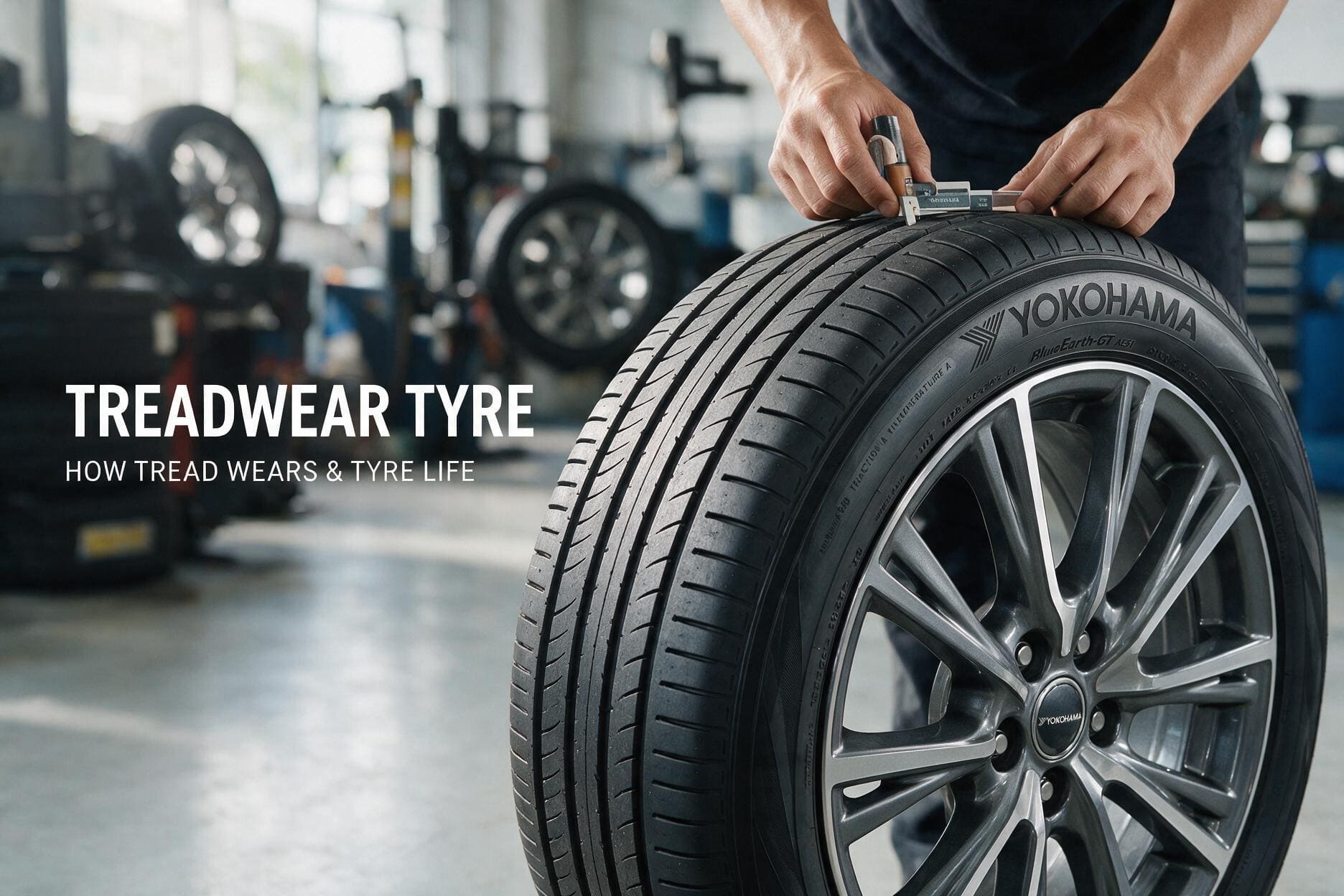
A treadwear tyre rating is the number moulded onto a tyre’s sidewall that estimates how long its tread should last compared with a reference tyre tested under controlled conditions. In plain terms, it is a durability score: the higher the number, the more wear the tread is built to take before it runs out.
Every tyre you fit in Malaysia is a treadwear tyre in the practical sense, because every tread block is slowly grinding away each time you drive. Understanding how that wear works, how to read the grade, and how to slow it down is what separates tyres that reach their full service life from tyres that need replacing far too soon. This guide walks Malaysian drivers through the whole picture, from the UTQG number to the wear patterns you can spot in your own driveway.
What the Treadwear Grade Means on a Tyre
The treadwear grade is part of the Uniform Tire Quality Grading system, a labelling standard created by the United States National Highway Traffic Safety Administration in 1978. Under this system, every passenger tyre carries three marks moulded into the sidewall: a treadwear number, a traction letter, and a temperature letter. The treadwear figure is the one tied directly to how long the tread lasts.
That number is a comparative score, not a mileage promise. A tyre graded 200 should last twice as long on the test course as one graded 100, and a tyre graded 300 should wear three times as well as a tyre graded 100. The grades come from running test tyres in a convoy over a fixed loop and measuring how much tread is lost against a reference tyre.
Crucially, the grade is assigned by the tyre maker, so it works best when comparing tyres within the same brand rather than across different ones. A treadwear grade of 300 denotes a tyre expected to wear three times as well as one graded 100, but real mileage depends heavily on how and where you drive.
How to Read the UTQG Treadwear Number
Reading the grade is straightforward once you know where to look. Find the line on the sidewall that reads something like “TREADWEAR 400 TRACTION A TEMPERATURE A”, then focus on the figure after the word treadwear. That figure is your durability indicator.
Higher numbers point to longer-wearing rubber compounds, which suits the high-mileage driving most Malaysian commuters do between home, work, and the occasional balik kampung trip. Lower numbers usually belong to softer, grippier performance compounds that trade longevity for cornering bite. Knowing this lets you match the tyre to your priorities before you buy, and it pairs naturally with checking the rest of the sidewall code so you read every marking correctly.
What Causes Tyre Tread to Wear
Tread wears because rubber is constantly being scrubbed against the road every time you accelerate, brake, or turn. That friction is unavoidable, but several factors decide whether your tread wears slowly and evenly or quickly and unevenly. The main culprits are inflation pressure, wheel alignment, suspension condition, and driving style.
Incorrect tyre pressure is the most common accelerator of wear in Malaysia, where heat and long highway runs are routine. Underinflation flexes the sidewalls and wears the outer edges of the tread, while overinflation bulges the centre of the tread so the middle wears faster than the shoulders. Both shorten tread life, and both are easy to avoid by checking pressure against the figure on the sticker inside your driver’s door, a habit covered in our note on optimal air pressure.
Alignment and suspension faults are the next big cause. When the wheels are out of alignment, one edge of the tread can wear far faster than the other, and worn suspension components let the tyre scrub sideways as it rolls. Aggressive acceleration, hard braking, and fast cornering then layer extra stress on top, which is why two drivers on identical tyres can see very different lifespans.
How Treadwear Relates to Tread Depth and Tyre Life
Treadwear and tread depth are two sides of the same coin: the grade predicts the rate of wear, while tread depth measures how much usable tread is left right now. As the tread wears, depth falls, and once depth drops past a safe threshold the tyre has reached the end of its useful life regardless of how high its original grade was.
The legal floor in Malaysia is clear. The Road Transport Department (JPJ) requires a minimum tread depth of 1.6 mm, and from June 2025 commercial vehicles must meet that 1.6 mm depth across the entire contact surface to pass inspection. Most tyres make this easy to check because they carry moulded tread wear indicators, small raised bars in the grooves that sit flush with the tread when depth reaches 1.6 mm.
Safety, however, fades well before the legal limit. Testing has found that wet braking distance can be up to 44 percent longer at the 1.6mm limit than at 3mm of tread, with grip falling steadily over the final millimetres. That is why many safety bodies suggest replacing tyres at around 3mm rather than waiting for 1.6mm. If you want to gauge where your own tyres sit, our walkthrough on how to check your tread depth shows the coin and gauge methods, and our guide to how long tyres last puts depth in the context of overall tyre age.
How to Slow Treadwear and Extend Tyre Life
You cannot stop tread from wearing, but you can slow it dramatically with a few low-cost habits. The goal is to spread wear evenly and remove the stresses that chew through rubber prematurely, which keeps every tyre closer to the lifespan its treadwear grade promised.
Rotating your tyres is the single most effective routine. Because each wheel position takes a different share of steering, braking, and drive forces, tyres wear at different rates front to rear, so swapping their positions evens things out. Industry guidance recommends rotating tyres every 5,000 to 8,000 miles, roughly 8,000 to 13,000 km, when no other interval is specified, and notes that fresh, deep tread is especially prone to uneven wear early in its life.
Correct inflation and alignment do the rest of the heavy lifting. Keeping pressure at the recommended figure stops the edge and centre wear described earlier, and a wheel alignment check after kerb knocks or pothole hits keeps the tread sitting flat on the road. Gentler throttle and braking inputs reduce scrubbing, and these steps together also help you spot the early signs that signal it is time to plan ahead, which our guide on when to change car tyres explains in detail.
Common Tyre Wear Patterns and What They Mean
Reading the wear pattern on a tyre tells you why it is wearing and what to fix. A quick look at the tread surface often diagnoses a problem long before it becomes dangerous, so it pays to glance at all four tyres regularly.
Centre wear, where the middle of the tread is balder than the shoulders, usually points to overinflation. Wear on both outer edges with a healthier centre signals the opposite problem of underinflation. Wear concentrated on just one edge typically means a camber or alignment fault, while a scalloped or feathered pattern, where tread blocks are higher on one side than the other, points to alignment or worn suspension parts. If you notice any of these, our explainer on uneven tyre wear covers the fixes, because catching the cause early saves the rest of the tread.
Choosing a Tyre Built to Wear Well
When tread life matters, the brand behind the tyre matters too. Yokohama is an award-winning Japanese tyre brand established in 1917, and it was the first Japanese tyre maker to earn ISO 9001 certification, the international standard for quality management. That heritage of engineering discipline is exactly what produces consistent, long-wearing tread compounds.
Yokohama builds its range around three product lines, each tuned for a different kind of driver in Malaysia. The ADVAN line delivers performance-focused grip and response, the GEOLANDAR line is engineered for SUVs and light trucks across mixed terrain, and the fuel-efficient BluEarth line is designed for low rolling resistance and everyday economy. Whichever suits your car, every tyre is backed by the We Care Road Hazard Warranty and supported by authorised dealers nationwide, with Yokohama Tyre Sales Malaysia as the sole official importer.
So treat treadwear as a number you can manage, not just one you read off the sidewall. Keep your pressure right, rotate on schedule, fix alignment early, and start with a quality tyre, and your tread will go the distance. Explore the full range and find your nearest authorised dealer at Yokohama.
Frequently Asked Questions
What is a good treadwear rating for a tyre in Malaysia?
For everyday commuting and highway driving, a treadwear grade in the 400 to 600 range generally offers a sensible balance of longevity and grip. Drivers who prioritise sporty handling may accept a lower grade in exchange for stickier rubber, while those chasing maximum mileage can look higher. Remember that the grade is most reliable when comparing tyres from the same brand.
How do I know when my treadwear tyre needs replacing?
Check the tread wear indicator bars in the grooves. When the surrounding tread wears down level with these bars, depth has reached the 1.6 mm legal minimum and the tyre must be replaced. For better wet-weather safety, many experts suggest replacing at around 3 mm rather than waiting for the bars to show.
Does a higher treadwear number guarantee more kilometres?
No. The treadwear grade is a comparative laboratory and test-track estimate, not a mileage warranty. Real-world life depends on inflation, alignment, road surfaces, climate, and driving style, so two drivers on the same tyre can record very different mileage.
How often should I rotate my tyres to reduce treadwear?
A common guideline is every 5,000 to 8,000 miles, or about 8,000 to 13,000 km, unless your vehicle handbook says otherwise. Rotation spreads wear across all four tyres and is especially worthwhile early in a tyre’s life when fresh tread wears unevenly most easily.
Sources
- National Highway Traffic Safety Administration – Consumer Guide to Uniform Tire Quality Grading
- National Highway Traffic Safety Administration – Tire Safety Ratings and Awareness, TireWise
- U.S. Tire Manufacturers Association – Tire Care & Safety
- RAC – Tyre Tread Depth, UK Law and Tyre Safety Checks
- Paul Tan’s Automotive News – Minimum 1.6 mm tread depth across entire tyre surface a must for all commercial vehicles, JPJ
- Yokohama Tyre Malaysia – Home