
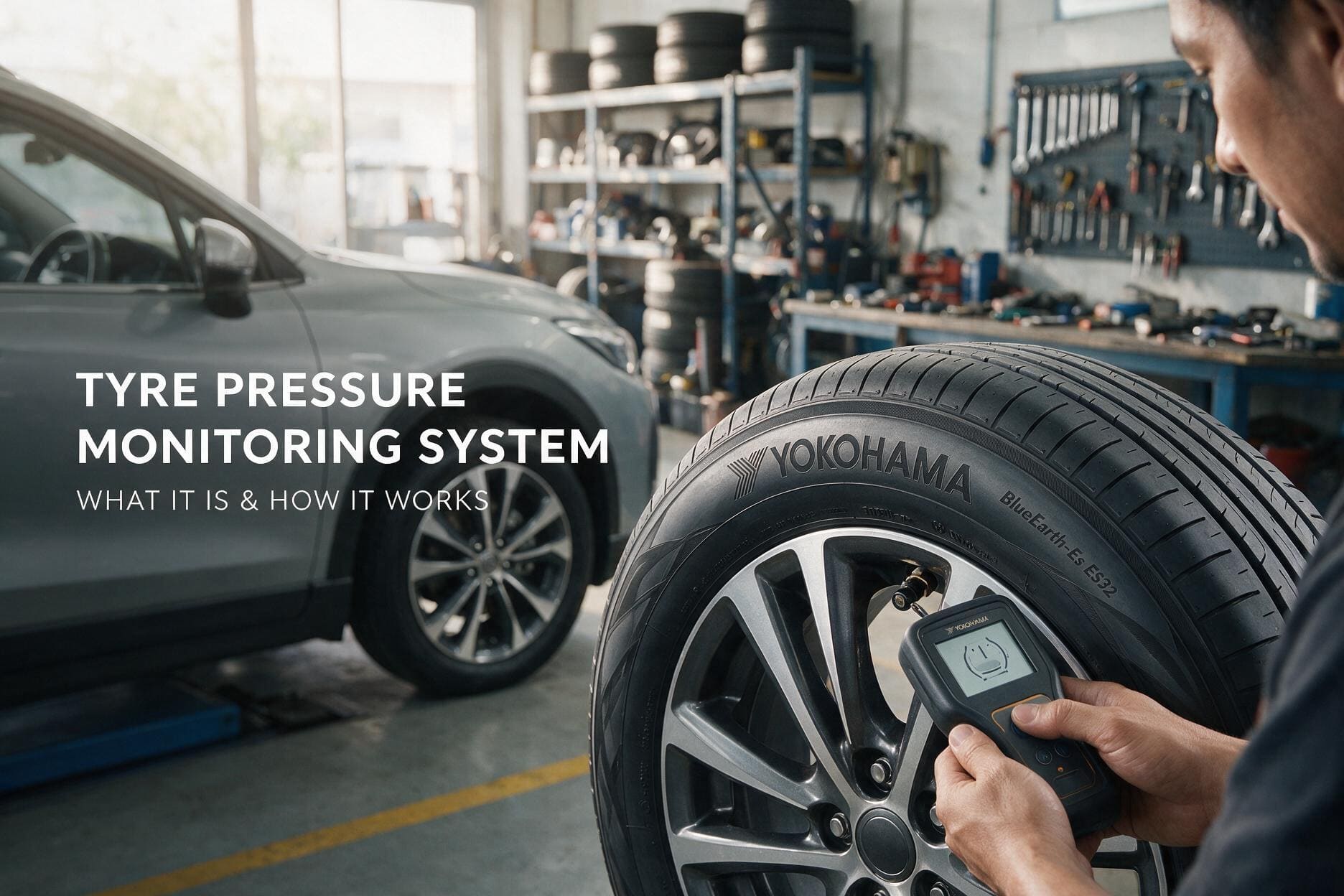
A tyre pressure monitoring system is an electronic safety feature that watches the air pressure in your tyres and warns you on the dashboard when one or more falls too low. It removes the guesswork from a hidden problem, because a tyre can lose a dangerous amount of air long before the eye can see it.
That hidden quality is exactly why the technology became mandatory on so many vehicles. A soft tyre changes how a car stops, steers, and burns fuel, yet it rarely looks flat until the loss is severe. The sections below explain what the system is, the two ways it works, why it matters for safety, and the practical steps every driver in Malaysia should know.
The TPMS Warning Symbol on Your Dashboard
The tyre pressure monitoring system speaks to you through a single icon. It looks like a horseshoe or a cross-section of a tyre with an exclamation mark in the centre, and it glows amber when the system detects a problem. Recognising that symbol is the first skill every driver needs, because it is easy to mistake for an unrelated alert.
The light has two moods worth knowing. A steady amber glow means at least one tyre has dropped below the safe threshold and needs attention. A symbol that flashes for about a minute at start-up and then stays lit usually points to a system fault rather than a low tyre, which is a different problem to solve. Either way, the warning is asking you to act rather than to ignore it.
How a Tyre Pressure Monitoring System Works
Every TPMS does the same job, alerting the driver to pressure loss, but manufacturers achieve it in two distinct ways. Both feed their findings to the vehicle’s electronic control unit, which then decides whether to light the dashboard warning. Understanding the difference helps you know what your car can and cannot measure.
Direct TPMS
Direct TPMS measures the actual pressure inside each tyre using a physical sensor. These sensors sit inside the wheel, either clipped to the valve stem or banded to the drop centre of the rim, and many also report tyre temperature alongside pressure. They transmit real-time readings by radio to the car’s receiver, which is why a direct system can often show the exact pressure for each individual wheel on the display.
The strength of this approach is accuracy, since it reports a true gauge reading rather than an estimate. Each sensor runs on a small internal battery, a detail that matters later when the time comes to service or replace it. Because the hardware lives inside the tyre, direct sensors also need attention whenever a tyre is changed or refitted.
Indirect TPMS
Indirect TPMS carries no pressure sensors at all and instead borrows the wheel-speed sensors already fitted for the anti-lock braking system. The principle is clever, drawing on the fact that a tyre’s effective rolling radius shrinks as it loses air. A softer tyre is slightly smaller, so it must spin a little faster than its properly inflated neighbours to cover the same distance, and the system reads that difference in rotational speed as a sign of low pressure.
Because it works by comparison rather than measurement, an indirect system does not display an actual pressure figure and cannot tell you which tyre is low with the same precision. It is cheaper to build, since it reuses existing components, but it also has to be reset after you adjust pressures or rotate the tyres so that it learns the new baseline. The two approaches are explored in more depth in this overview of how a tyre pressure monitoring system uses radio sensors inside each wheel for direct designs and existing braking sensors for indirect ones.
Why Tyre Pressure Monitoring Matters
A tyre pressure monitoring system matters because under-inflation is one of the most common and most underestimated faults on the road. The benefits cluster around four areas, namely safety, even tread wear, fuel economy, and protection against sudden failure. Each one traces back to the simple physics of how a tyre behaves when it is short of air.
Safety and handling come first. A soft tyre flexes more in corners, which makes steering feel vague and lengthens the distance a car needs to stop, so a system that flags the problem early helps keep braking and grip where the driver expects them. The regulatory benchmark in the United States captures the stakes plainly, since a federal safety standard requires the warning to appear once a tyre sits 25 percent or more below the recommended cold pressure, the point at which under-inflation is treated as significant enough to demand attention.
Fuel economy is the next reason, and it is easy to feel at the pump. An under-inflated tyre presses more of its surface onto the road, raising rolling resistance and forcing the engine to work harder, and government testing shows that keeping tyres at the proper pressure can improve mileage by around 0.6 percent on average and up to 3 percent in some cases. Correct pressure also spreads the load evenly across the tread, so the tyre wears flat instead of scrubbing away its shoulders or its centre prematurely. Drivers who want to understand the target figure can review this guide to finding the optimal air pressure for your tyres for the practical numbers.
The fourth reason is the most dramatic. A tyre running low builds up heat as its sidewalls flex repeatedly, and heat is the enemy that can trigger a blowout at speed. Catching the pressure loss before it reaches that stage is the whole point of the warning, and it is also why noticing a slow leak early through a tyre pressure monitoring system can save a tyre that would otherwise be ruined, as explained in this look at the common reasons tyres lose pressure.
The Warning Light Came On: What to Do
When the tyre pressure monitoring system light appears, treat it as an instruction to check rather than a reason to panic. The right response is methodical and takes only a few minutes at a petrol station. Acting promptly protects both the tyre and everyone in the car.
Start by checking all four tyres with a gauge when they are cold, meaning before you have driven far, because driving warms the air and inflates the reading. Adjust each tyre to the figure on the vehicle placard, which usually sits on the driver’s door jamb or inside the fuel filler flap, and never to the maximum number moulded on the tyre sidewall. The correct value is the one the carmaker specifies for your model, since that figure balances grip, comfort, and load.
Inspect the tyre as you go, because a warning that returns soon after you inflate often means a puncture rather than a slow seasonal drift. Temperature alone can set the light off, since pressure changes by roughly one psi for every ten degree Fahrenheit shift in temperature, so a cool morning can dip a borderline tyre below the threshold. If the light keeps coming back after correct inflation, a nail or a valve leak is the likely culprit and the tyre needs a professional inspection.
Resetting TPMS and Common Faults
A tyre pressure monitoring system sometimes needs a reset rather than a repair, and knowing the difference saves an unnecessary workshop visit. Resets and faults are the maintenance side of the technology, distinct from the everyday warning about a soft tyre. Both come up over the normal life of a car.
A relearn or reset is routine after certain jobs. Rotating the tyres, fitting a new set, or swapping a wheel can confuse the system about which sensor sits where or what the correct baseline should be, so the procedure teaches it the new arrangement. Indirect systems in particular must be reset through the dashboard menu after you adjust pressures, because they treat the freshly corrected pressures as the reference point for future comparisons.
Genuine faults usually trace back to the sensors themselves. The batteries sealed inside direct sensors last for several years but eventually run flat, at which point the sensor stops transmitting and the system flags an error rather than a low tyre. A corroded valve, a sensor damaged during fitting, or radio interference can produce the same fault warning. When the symbol behaves oddly or stays lit despite correct pressures, the sensors are the place to look.
Aftermarket TPMS Kits for Older Cars
Drivers of older or budget vehicles without a factory system can still gain the same protection through an aftermarket tyre pressure monitoring system. These kits exist precisely because many cars on Malaysian roads predate the era when the feature became common. They bring real-time pressure awareness to a vehicle that never shipped with it.
Aftermarket kits generally come in two styles that mirror the factory approaches. One uses small sensors that screw onto each valve stem in place of the dust caps and send readings to a compact display on the dashboard, while another uses internal sensors fitted inside the tyre for a tidier installation. Both show live pressures and sound an alert when a tyre drops low, and the right choice depends on budget, accuracy, and how much fitting work you are willing to do. Choose a kit on its own merits and have internal sensors fitted by a tyre shop, since the principles described above apply regardless of the device.
TPMS and Driving in Malaysia
A tyre pressure monitoring system earns its keep in Malaysia’s particular climate and road conditions. Heat, heavy rain, and the legal tread requirement all interact with tyre pressure in ways that make the warning especially useful here. The local context turns a useful feature into a genuinely important one.
Heat is the constant factor. The country’s high ambient temperatures and hot tarmac raise the air pressure inside a rolling tyre, which is one reason the cold-pressure check matters so much, and a system that monitors the trend helps a driver tell a normal warm-weather rise from a real leak. The monsoon adds a second hazard, because correct pressure preserves the tyre’s contact patch and its ability to clear water, and good wet grip depends on both adequate pressure and sufficient tread.
Tread depth is where pressure and the law meet. Malaysian authorities enforce a minimum tread depth of 1.6 millimetres across the contacting surface of the tyre, the point at which a tyre is considered worn out and must be replaced. A correctly inflated tyre wears evenly and reaches that limit predictably, whereas a chronically soft one wears its edges away early and can fail an inspection sooner, so it is worth knowing how to check your tyre tread depth and recognising the signs that tell you when to change your car tyres before wear becomes a safety or compliance problem.
Keep Your Pressure Right With Yokohama in Malaysia
Correct tyre pressure only does its job when it sits inside a quality tyre, and that is where the right brand makes the difference between a warning you can act on and a failure you cannot. A tyre pressure monitoring system tells you the air is low, but the casing, the compound, and the build determine how safely the tyre carries that air through Malaysian heat and rain. Choosing a maker with a long engineering pedigree turns good pressure habits into dependable safety.
Yokohama is an award-winning Japanese tyre brand founded in 1917 and was the first Japanese tyre maker to earn ISO 9001 certification, a heritage of quality control that shows in how its tyres hold pressure and resist heat over their service life. The range covers three lines built for different needs, with the high-performance ADVAN for spirited and sporty driving, the rugged GEOLANDAR for SUVs and light trucks, and the fuel-efficient BluEarth for everyday economy. Every set is backed by the We Care Road Hazard Warranty and supported by authorised dealers nationwide, with Yokohama Tyre Sales Malaysia serving as the sole official importer.
When your monitoring system flags a tyre that has reached the end of its life, fit a replacement engineered to keep its pressure honest from the first kilometre to the last. Explore the full range and find your nearest fitting centre at Yokohama Tyre Malaysia.
Frequently Asked Questions
What does the tyre pressure monitoring system light mean?
It means the system has detected that at least one tyre is below the safe pressure threshold, or that the system itself has a fault. A steady amber light usually signals a low tyre, while a light that flashes at start-up and then stays on typically points to a sensor or system problem.
Can I keep driving when the TPMS light is on?
You can drive a short distance to a safe place to check and inflate the tyres, but you should not ignore the warning or drive far on a tyre that may be significantly under-inflated. Low pressure lengthens braking distances and raises the risk of a blowout, so check the tyres at the first opportunity.
What is the difference between direct and indirect TPMS?
Direct TPMS uses a sensor inside each wheel to measure the actual pressure, and often the temperature, then transmits that reading to the car. Indirect TPMS has no pressure sensors and instead uses the anti-lock braking system’s wheel-speed sensors to detect when a tyre is rotating faster because it has gone soft.
How do I reset my tyre pressure monitoring system?
After inflating, rotating, or replacing tyres, set every tyre to the correct cold pressure and then run the relearn procedure for your car, which is often a button or a dashboard menu option. Indirect systems usually need this reset so they record the corrected pressures as the new baseline.
Do TPMS sensors need a battery?
Direct TPMS sensors contain a sealed battery that lasts for several years before it runs flat, after which the whole sensor is replaced. Indirect systems have no in-tyre sensors and therefore no battery to replace.
Does a tyre pressure monitoring system replace manual checks?
No. A TPMS is a warning system that alerts you to a problem that has already developed, not a substitute for routine maintenance. Checking your tyres with a gauge at least once a month, when they are cold, remains the best habit.
Sources
- National Highway Traffic Safety Administration – Tire Pressure Monitoring System (FMVSS No. 138)
- TyreSafe – What is a Tyre Pressure Monitoring System (TPMS)?
- U.S. Department of Energy – Gas Mileage Tips: Keeping Your Vehicle in Shape
- Consumer Reports – Your Tire-Pressure Warning Light Just Came On. What Do You Do Now?
- Paul Tan’s Automotive News – Minimum 1.6 mm tread depth across entire tyre surface a must for all commercial vehicles, JPJ
- Yokohama Tyre Malaysia – Yokohama Tyre Sales Malaysia