
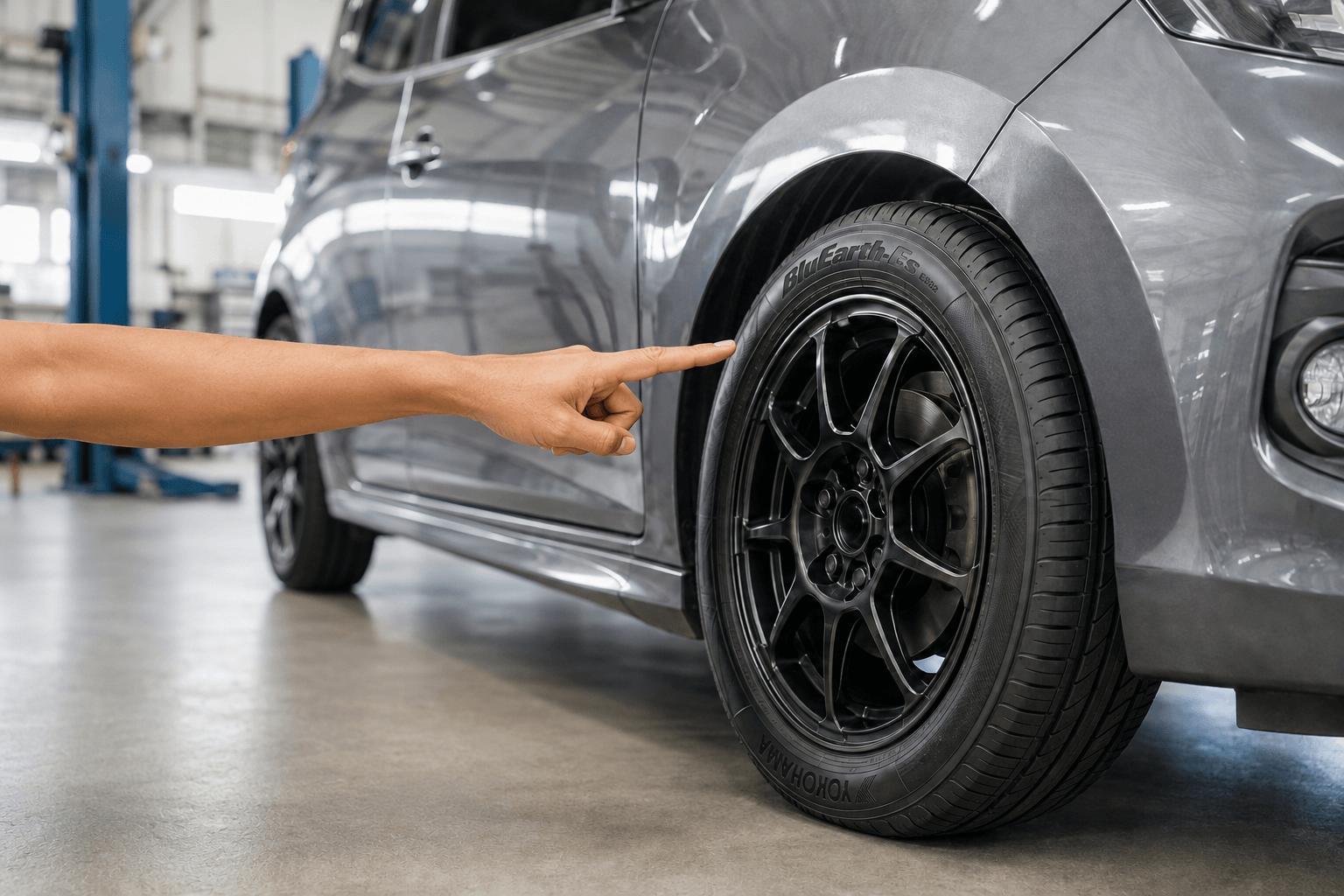
A tyre expiry date is the point at which a tyre becomes too old to be trusted on the road, judged from the date it was manufactured rather than from any printed sell-by label. Tyres carry no single legal expiry in Malaysia, yet most safety bodies advise replacing them around five to six years after manufacture and retiring any tyre by ten years, no matter how much tread is left.
That gap between expectation and reality trips up a lot of drivers. You can buy a tyre that looks brand new, fit it, and still be rolling on rubber that left the factory years ago. Understanding the date code stamped on every sidewall is the only reliable way to know how old your tyres truly are and when their useful life is running out.
Do tyres really have an expiry date?
Tyres do not come with a hard expiry date the way food does, but they unquestionably have a usable lifespan. There is no fixed legal age at which a tyre must be thrown away in Malaysia, and the industry itself disagrees on exactly when a tyre stops being safe, which is why no single standard expiry figure is stamped on the rubber. What everyone agrees on is that the clock starts ticking the moment a tyre is made.
In practice, that disagreement narrows to a sensible range. Several vehicle and tyre makers recommend replacing tyres that are six to ten years old regardless of treadwear, and the more cautious advice is to budget for new tyres at around five years and to treat ten years from manufacture as a firm ceiling. The reasoning is simple: rubber is a chemically active material, and time degrades it whether or not the tyre ever turns a wheel.
This matters most for tyres that wear slowly. A daily commuter usually wears the tread down long before age becomes the deciding factor, but a weekend car, a spare, or a low mileage vehicle can keep plenty of tread while the rubber quietly hardens past its best. For a fuller view of how mileage and time interact, our guide on how long a set of tyres can last before it needs changing is a useful companion to this article.
How to read the tyre date code on the sidewall
Every tyre carries a manufacturing date in a code on its sidewall, and reading it takes only a few seconds once you know where to look. The date sits at the end of the Tyre Identification Number, where the last four digits record the week and year the tyre was built. The first two digits are the week, running from 01 to 52, and the last two are the year.
A worked example makes it concrete. A tyre marked 4025 was made in the fortieth week of 2025, which works out to late September or early October of that year. A code reading 0823 means the eighth week of 2023. If you ever find only a three digit code, the tyre was made before the year 2000 and should be replaced without hesitation.
Finding the code is the only fiddly part. On many tyres the full four digit date appears on one sidewall only, so you may need to look on both the inner and outer faces, often inside a small oval or rectangular window after the letters DOT. The date code is just one part of a longer string of sidewall markings, and our walkthrough on how to read the full set of tyre markings and codes decodes the size, load, and speed information stamped alongside it.
Why tyres age even when they are barely used
Tyres age from the inside out, driven by chemistry rather than mileage. Rubber is a blend of natural and synthetic compounds, and how those properties change depends on a mix of time, storage conditions, and use, so calendar age alone cannot perfectly predict the serviceable life of any single tyre. Even so, the direction of travel is always the same. Older rubber is harder, less flexible, and more prone to failure.
Three environmental forces do most of the damage. Ultraviolet light from the sun breaks down the rubber’s chemical bonds, heat speeds up every reaction inside the compound, and ozone in the air attacks the surface to leave fine cracks. As these processes continue, the oils that keep the rubber supple migrate out and the tyre slowly stiffens, a change you cannot see from tread depth and often cannot feel until grip is already compromised.
Storage conditions decide how fast this happens. A tyre kept cool, dark, and away from the weather ages far more slowly than one parked outdoors in full sun. The same logic explains why a spare wheel tucked under a boot floor can still be unsafe at ten years old despite never touching tarmac.
The warning signs of an aged tyre
An ageing tyre usually leaves visible and physical clues before it fails, and knowing them lets you act early. The most telling sign is fine cracking on the sidewall, sometimes called crazing or dry rot, which appears as a web of shallow lines as the rubber loses its flexibility with age. Bulges or blisters on the sidewall are more serious still, since they point to internal damage that can lead to a sudden blowout.
Behaviour on the road offers further warning. New vibration through the steering wheel, uneven or accelerated wear, and a general loss of grip in the wet can all accompany an old or deteriorating tyre. Tread depth is the final hard limit: once any tyre drops below the legal minimum it must be replaced regardless of its age, and an old tyre frequently reaches that point with cracking already well advanced.
Cracking in particular is worth taking seriously rather than ignoring. Our detailed guide to what causes cracked tyres and how to prevent them explains why surface crazing is a signal to have a tyre inspected before it turns into a more serious failure.
Check the date code before you buy, not just after
The smartest time to use the date code is before money changes hands. Because tyres can sit in storage for months or years, a tyre sold as new is not necessarily freshly made, and buyers who never check the date can end up paying full price for rubber that has already lost part of its life. Reading the four digit code at the point of purchase is the single best defence against old stock.
Industry opinion does soften this slightly. There is a reasonable argument that a tyre stored correctly in a cool, dry warehouse ages far more gently than one in service, since storage spares it the heat, load, and flexing of daily driving. The practical takeaway is balanced rather than alarmist: a tyre a year or so old that has been stored properly is generally fine, while one already several years old at the time of sale is poor value and worth refusing.
Where you buy makes a real difference here. Purchasing through an authorised channel rather than grey market stock greatly reduces the odds of being handed tyres that have languished unsold for years. It is the same principle that applies to deciding when it is genuinely time to change your car tyres: fresh, correctly sourced rubber is the foundation everything else builds on.
Tyre ageing in Malaysia’s hot, humid climate
Malaysia’s climate is close to a worst case scenario for tyre ageing, which makes the date code even more relevant here than in cooler countries. Year round heat, intense equatorial ultraviolet exposure, and high humidity all accelerate the chemical breakdown of rubber, so a tyre in Malaysia can reach the cautious end of its safe life sooner than the same tyre in a temperate climate. Cars left parked outdoors all day feel this most acutely.
The legal backstop in Malaysia is tread depth rather than age. The minimum legal tread depth across the contact surface of a tyre is 1.6mm, a limit the road transport department has been enforcing more strictly, and dropping below it makes a tyre illegal as well as unsafe. Checking tread is quick, and our explainer on how to check your tread depth shows the simplest methods.
Putting the two together gives Malaysian drivers a clear routine. Read the date code so you know the tyre’s age, inspect the sidewalls for cracking once a tyre passes five years, and measure tread against the 1.6mm limit, replacing whenever either age or wear says the time has come. In a climate this harsh, erring towards earlier replacement is the safer habit.
Fit Fresh, Trust the Date: Choosing Yokohama in Malaysia
Knowing how to read a tyre expiry date is only half the job; the other half is fitting tyres you can trust from the first week of their life. This is where the brand behind the rubber counts, because a manufacturer with a long record of quality control gives you confidence that what you fit is made to last and sourced correctly.
Yokohama is an award winning Japanese tyre brand that has been making tyres since 1917 and was the first Japanese tyre maker to earn ISO 9001 certification, a heritage that speaks directly to consistency and freshness. In Malaysia the range covers three clearly defined families: the performance focused ADVAN line, the SUV and off road GEOLANDAR line, and the fuel efficient BluEarth line. Every Yokohama tyre is backed by the We Care Road Hazard Warranty and supported by authorised dealers nationwide, and because Yokohama Tyre Sales Malaysia is the sole official importer, buying through that official channel is also your best protection against old, unofficially imported stock.
So when the date code tells you it is time for new tyres, choose fresh rubber from a brand built on more than a century of Japanese engineering. Explore the full range and find your nearest authorised dealer at Yokohama.
Frequently asked questions
How long do tyres last?
Most tyres last somewhere between five and ten years, with the exact figure depending on use, storage, and climate. Heavily driven tyres usually wear out on tread before age matters, while lightly used tyres tend to age out first, and many manufacturers treat six to ten years from the manufacturing date as the window in which a tyre should be replaced regardless of remaining tread.
Are 7 year old tyres ok?
A seven year old tyre can still be roadworthy, but it sits firmly in the zone where it should be inspected by a professional at least once a year. By seven years the rubber has degraded noticeably even if the tyre looks acceptable, so any sidewall cracking, bulging, or loss of grip is reason to replace it, and reaching ten years from manufacture is widely treated as the point to retire a tyre outright.
How do I check a tyre expiry date?
You check a tyre’s age by reading the last four digits of the DOT code on its sidewall, where the first two digits are the week of manufacture and the last two are the year. A code of 3024, for example, means the thirtieth week of 2024. Compare that date with today to work out the tyre’s age, and remember the full code may appear on only one side of the tyre.
What does a code like 4025 mean on a tyre?
A four digit code such as 4025 tells you the tyre was made in the fortieth week of 2025. Reading it as week then year is the universal convention, so 0124 would be the first week of 2024 and 5223 the fifty second week of 2023. Any tyre showing only three digits predates the year 2000 and should be replaced immediately.
Sources
- The AA – Tyre age: how many miles do tyres last?
- National Highway Traffic Safety Administration – Tire Safety Ratings and Awareness (TireWise)
- U.S. Tire Manufacturers Association – Tire Care and Safety
- TyreSafe – Frequently Asked Questions on Tyre Safety
- Paul Tan’s Automotive News – Are new tyres stored for 2 to 3 years expired goods?
- Paul Tan’s Automotive News – Minimum 1.6mm tread depth across entire tyre surface a must, says JPJ