
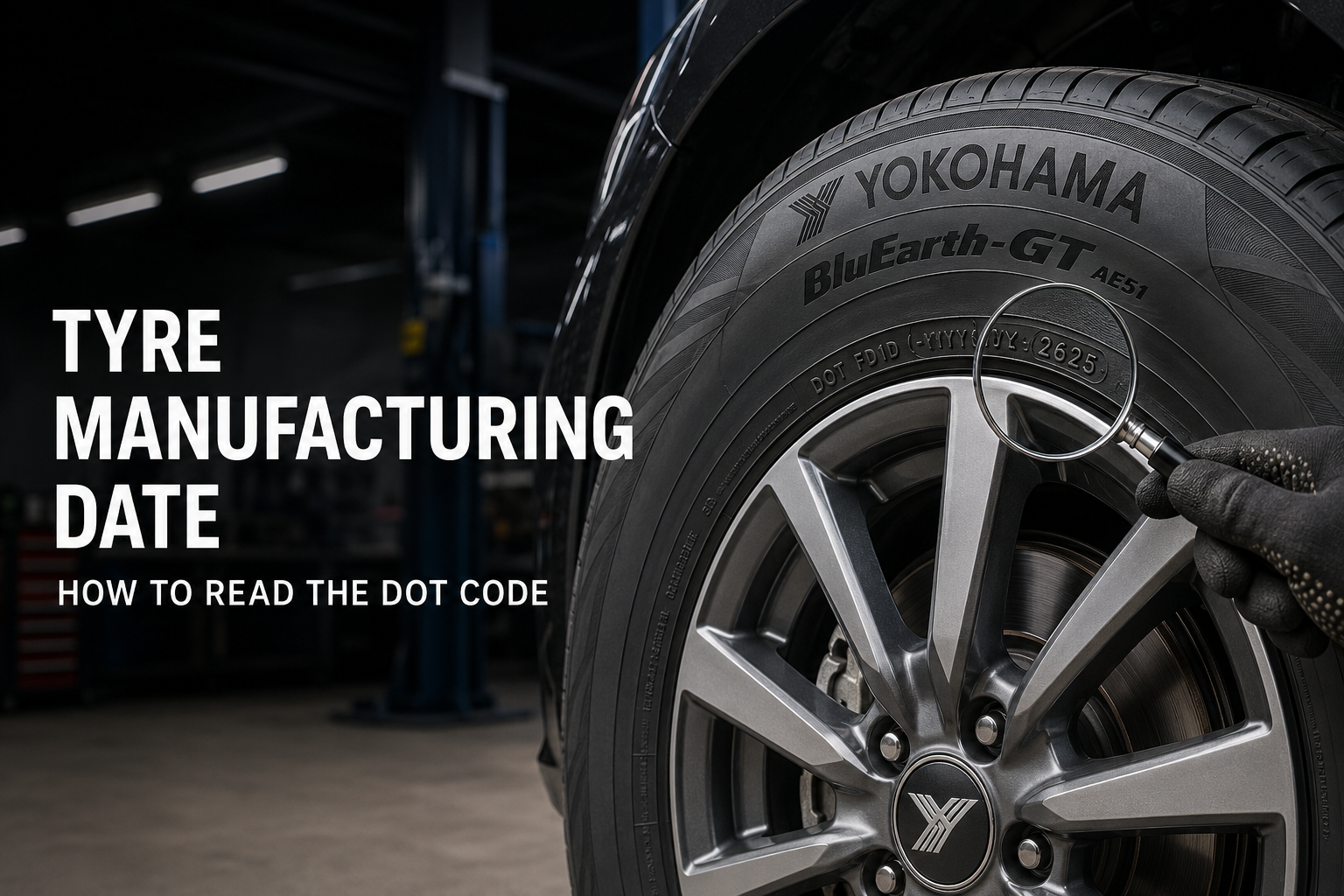
The tyre manufacturing date is the week and year a tyre was built, stamped into the sidewall as the last four digits of the DOT code. Knowing how to read it lets you judge a tyre’s true age, gauge its remaining safe life, and avoid paying full price for old stock when you shop for tyres in Malaysia.
What the Tyre Manufacturing Date Actually Tells You
The date on the sidewall records when the tyre left the factory, not when it was sold or fitted. Every tyre made for road use carries a Tire Identification Number that begins with the letters “DOT”, and the final group of that number is the production date. The date code uses the first two symbols for the week of the year and the last two for the year of manufacture. This same code appears on tyres sold here, which is why it is the single most reliable way to verify a tyre’s age before you buy.
Reading the four-digit code is straightforward once you know the pattern. A code that ends in “2519” means the tyre was built in the 25th week of 2019, while “0823” points to the 8th week of 2023. The week runs from 01 for the first full calendar week up to 52, and the year is given by the last two digits. So a tyre stamped “5024” rolled off the line in late 2024, near the end of the year.
It helps to know where to look, because the full date code is usually printed on one side only. Manufacturers often place the complete DOT number on the inner sidewall, the face that points toward the vehicle, so you may need to turn the wheel or check from underneath. If you want a fuller walkthrough of every marking on the rubber, our guide on how to read tyre markings and codes breaks down the load index, speed rating, and size alongside the date.
Why the Tyre Manufacturing Date Matters for Safety
Rubber ages whether or not a tyre is driven, which is the core reason the production date matters. A tyre is a chemical product, and from the moment it is cured it begins to oxidise, as oxygen slowly hardens the flexible compounds and makes them brittle. The bonds formed during manufacturing gradually break down over years of heat cycles, so even an unused tyre loses elasticity with time.
This ageing has direct consequences on the road. As the compound stiffens and develops fine cracks, the risk of tread and belt separation rises, and a separation at speed can cause a sudden loss of control. The danger is that the tread can still look deep and healthy while the structure underneath has quietly degraded, which is exactly why date matters as much as wear.
Because the failure mode is hidden, age-based inspection is the sensible response. Many vehicle makers advise replacing tyres around six years after the production date regardless of tread depth, and a common rule of thumb is to have any tyre over five years old checked by a professional at least once a year. For a deeper look at expected service life and the factors that shorten it, see our article on how long tyres last.
Manufacturing Date vs Purchase Date vs Expiry Date
These three dates are easy to confuse, yet they measure very different things. The manufacturing date is fixed at the factory and never changes, while the purchase date is simply the day you bought the tyre, which can fall years later. The gap between them is the part most buyers overlook, and it can quietly eat into the safe life you are paying for.
Tyres do not carry a hard “expiry date” printed like food packaging, so the idea of expiry is really a guideline built on the manufacturing date. Industry and consumer-safety bodies treat the production date as the clock, with caution advised once a tyre passes five to six years and many sources naming roughly ten years as an outer limit even for lightly used rubber. In Malaysia there is no specific law setting a maximum tyre age for sale or use, so the manufacturing date and these published guidelines are the practical benchmarks drivers rely on.
The takeaway is to count a tyre’s age from when it was made, not from when you fitted it. A tyre bought today but built three years ago has already used a meaningful slice of its recommended life before its first kilometre. That single insight is what makes checking the date code at the point of sale so valuable.
How the Date Relates to Tyre Age and Replacement
Tyre age and tread wear are two separate measures, and a responsible replacement decision weighs both. Tread depth tells you how much grip remains for braking and wet handling, while the manufacturing date tells you how much the rubber has chemically aged. A tyre can fail either test first, so passing one does not excuse ignoring the other.
In practice this means a low-mileage car can still need new tyres. A vehicle that sits unused, or one fitted with barely worn tyres that are nonetheless old, may carry hard, cracked rubber that grips poorly in the wet despite plenty of visible tread. Heat and strong sunlight, both abundant in the Malaysian climate, accelerate this hardening, so age can matter even more here than in cooler countries.
Regular checks turn this knowledge into action. Inspect every tyre on the car, including the spare, for cracking on the sidewall and tread grooves, and pair that visual check with the date code to decide whether age or wear is the limiting factor. If you are weighing up the signs, our guide on when to change car tyres lays out the warning signals worth watching.
How to Check for Old Stock Before Buying Tyres in Malaysia
Old stock is new, unused tyres that have been sitting in storage for years, and the manufacturing date is your only defence against it. Because a tyre’s clock starts at the factory, a “new” tyre built three or four years ago has already aged on the shelf before you drive it. Storage conditions matter too, since tyres kept in heat or poor conditions degrade faster than the date alone suggests.
Checking is quick and worth doing every time. Before you commit, ask to read the DOT code on the actual tyres being fitted, not a catalogue figure, and confirm the week and year fall within the last year or so for genuinely fresh stock. As a working benchmark, many buyers treat tyres more than two to three years old at the point of sale as worth questioning, and anything close to five years as old stock to avoid unless the price clearly reflects it.
Two extra points protect your wallet and your warranty. First, age can erode the coverage period, since manufacturer warranties typically run from the manufacturing date rather than the purchase date, so older stock leaves you fewer protected years. Second, never accept significantly older rubber at full price, because the shortened safe life means you are paying new-tyre money for a used-up portion of the tyre’s life.
Buying Fresh, Trusted Tyres in Malaysia
When date and quality both matter, choosing an established brand with a controlled supply chain reduces the risk of old stock. Yokohama is an award-winning Japanese tyre brand established in 1917, and the Yokohama tyre division was the first Japanese tyre maker to earn ISO 9001 certification, a globally recognised quality-management standard. That heritage of quality assurance is exactly what you want standing behind the date code on your sidewall.
The Yokohama range covers the way Malaysians actually drive, across three clearly defined product lines. The ADVAN line delivers performance and sporty handling, the GEOLANDAR line is built for SUVs and light trucks on road and rough ground, and the fuel-efficient BluEarth line focuses on economy and comfort for everyday driving. Each line is engineered to the same Yokohama standards, so buyers can match a tyre to their vehicle without trading away quality.
Buying through the right channel is what guarantees fresh stock and full support. Yokohama Tyre Sales Malaysia is the sole official importer for the country, supplying authorised dealers nationwide who carry current production and honour the brand’s coverage, including the We Care Road Hazard Warranty that protects against eligible road damage. To check the latest fresh-stock tyres, find an authorised dealer near you, or read more on the ADVAN, GEOLANDAR, and BluEarth ranges, visit Yokohama.
Frequently Asked Questions
How do I read the tyre manufacturing date on my sidewall?
Find the DOT code on the sidewall and read its last four digits. The first two are the week of the year and the last two are the year, so “3622” means the 36th week of 2022. The complete code is often on the inner sidewall, so you may need to look at the back face of the tyre.
How old is too old for a tyre in Malaysia?
There is no specific Malaysian law setting a maximum tyre age, so published safety guidelines apply. Many vehicle makers advise replacing tyres about six years from the manufacturing date regardless of tread, and roughly ten years is widely treated as an outer limit even for lightly used tyres. The hot local climate can speed up ageing, so earlier inspection is wise.
Is a tyre’s age counted from the manufacturing date or the purchase date?
Age is counted from the manufacturing date stamped on the sidewall, not the day you bought or fitted it. This matters because rubber begins ageing at the factory, so a tyre that sat in storage for years is already partway through its safe life on the day you buy it.
Can I tell the manufacturing date from the tread depth?
No. Tread depth measures wear from use, while the manufacturing date measures chemical age. A tyre can have plenty of tread yet be old and hardened, which is why both should be checked together.
Should I buy tyres that are a few years old if the price is lower?
Be cautious. A tyre’s warranty and safe life run from the manufacturing date, so older stock gives you fewer protected and usable years. Only consider it if the discount clearly reflects the lost life, and check the DOT code before agreeing to the fitting.
Sources
- NHTSA – Tires
- eCFR – 49 CFR 574.5: Tire Identification Requirements
- U.S. Tire Manufacturers Association – Tire Care & Safety
- The AA – Tyre Age: How Many Miles Do Tyres Last?
- paultan.org – Are new tyres stored for 2-3 years “expired goods?”
- Yokohama Tyre Malaysia – Home