
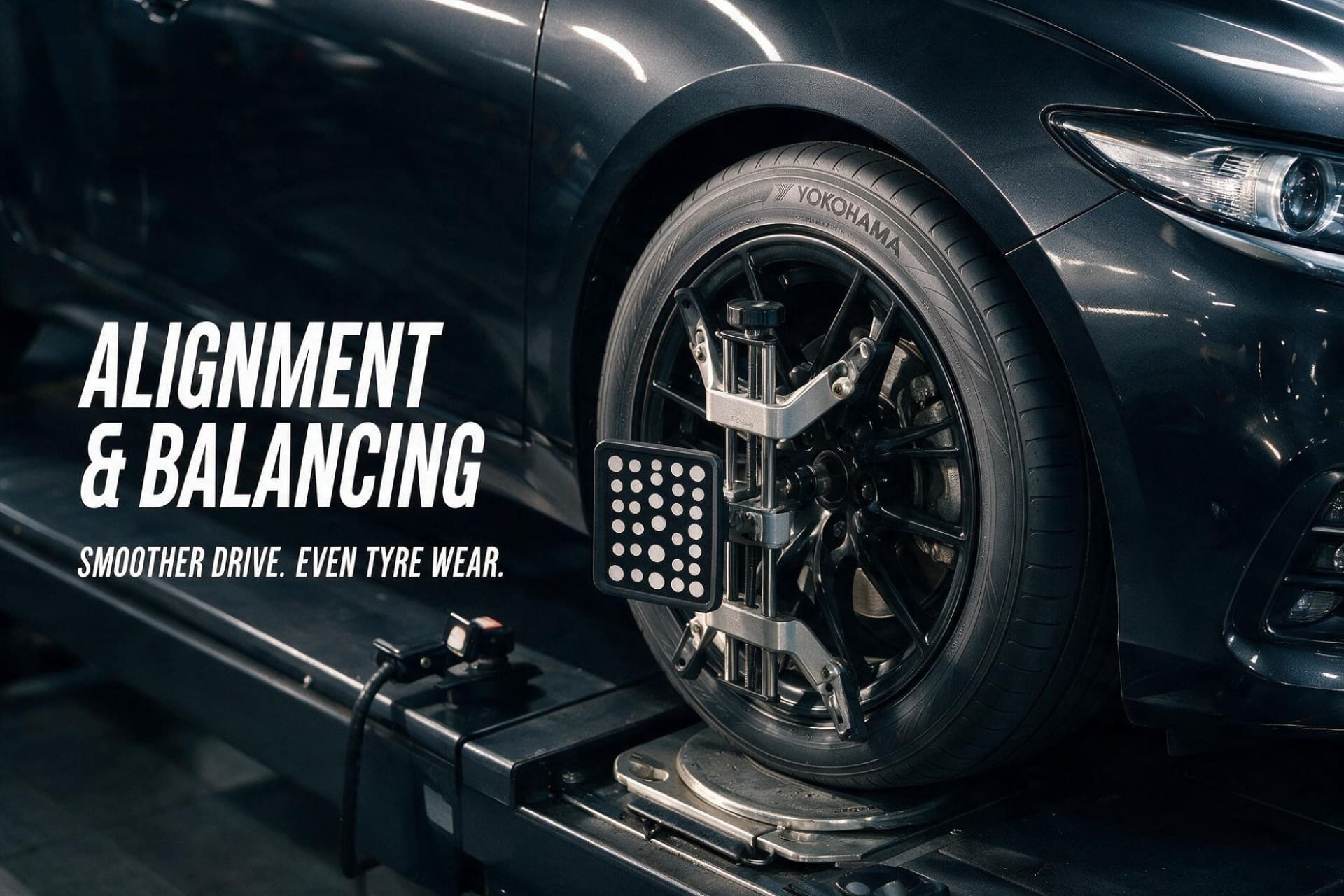
Alignment and balancing are two separate wheel services that people often confuse, yet each fixes a different problem in how your car meets the road. Alignment adjusts your suspension angles so the tyres sit at the correct angle, while balancing evens out the weight of the tyre-and-wheel assembly so it spins without vibration.
Because the two jobs target different faults, understanding when you need one, the other, or both can save you money and stop premature tyre wear on Malaysian roads. This guide compares alignment and balancing side by side, explains why workshops usually bundle them, and answers the common question of which one should come first.
What Alignment Means
Wheel alignment is the adjustment of your car’s suspension, not the wheels or tyres themselves. A technician sets the angles at which the tyres meet the road back to the vehicle maker’s specification, so the contact patch stays square and the car tracks straight. The three angles that matter are camber, caster, and toe.
Camber is the inward or outward tilt of the tyre when you look at it head-on, and an incorrect tilt wears one edge of the tread faster than the other. Caster is the angle of the steering axis, which governs how the car corners and how the wheel self-centres after a turn. Toe is whether the tyres point slightly inward or outward when viewed from above, and even a small toe error scrubs the tread and drags on fuel economy. Getting these angles right is why proper alignment maximises tyre life and stops the car veering left or right on a straight, level road, according to guidance that groups tyre balancing and wheel alignment as core maintenance for safety and tyre life.
What Balancing Means
Wheel balancing corrects uneven weight distribution around the tyre-and-wheel assembly so it rotates smoothly. No tyre and rim combination is perfectly even out of the box, and heavy spots throw the assembly off as it spins. A technician mounts the wheel on a balancing machine, spins it to find the heavy points, and clips or sticks small counterweights onto the rim to cancel them out.
This is the process of adding small weights to the wheel to correct uneven weight distribution so the tyre wears evenly and the car does not shake at speed. Balancing is purely about mass and rotation, so it never touches the suspension. It simply makes sure each wheel spins true, which is why new tyres should always be balanced the moment they are fitted.
Alignment and Balancing Compared Side by Side
The clearest way to separate alignment and balancing is by what each one actually fixes. Alignment is a geometry job that repositions the suspension so the tyres point and lean correctly, whereas balancing is a weight job that smooths out how the assembly spins. One deals with angles, the other with mass, and neither substitutes for the other.
The symptoms point to different faults, which is the fastest way to tell which service you need. Alignment trouble shows up as the car pulling to one side on a straight road, a steering wheel that sits off-centre when you are driving straight, and uneven tread wear across a tyre. Balancing trouble shows up as a vibration you feel through the steering wheel, the seat, or the floor, and that vibration typically appears and grows as you pick up speed. In practice, a pull or crooked steering wheel is an alignment clue, while a shimmy that worsens above roughly 70 to 80 km/h is a balancing clue.
The tools and the parts touched are different too. A balance is done on a spinning machine with counterweights added to the rim, while an alignment is done on a rack with sensors on each wheel, adjusting suspension components to factory angles. Both services protect your tread, both make the car smoother, and both stretch tyre life, but they arrive at that result by fixing opposite problems.
Why Alignment and Balancing Are Usually Done Together
Workshops bundle alignment and balancing because both are triggered by the same events and both protect the same asset, your tyres. A pothole, a kerb strike, or a set of new tyres is a reason to check the angles and the weights at once, so pairing them saves a second visit and a second round of labour. The P.A.R.T. checklist of Pressure, Alignment, Rotation, and Tread treats these tasks as one routine rather than isolated repairs.
The two services also complement each other rather than overlap. Balancing removes the vibration that would otherwise mask a subtle pull, and alignment corrects the geometry that would otherwise chew through the tread that balancing kept smooth. Done together, they give you a car that tracks straight, rides without shimmy, and wears its tyres evenly. This is also the moment to have the workshop check whether any tyre is near the 1.6 mm legal minimum tread depth, since worn tyres will not perform even on a perfectly aligned and balanced car. If you are seeing patchy or one-sided wear, our guide on reading the signs of uneven tyre wear explains what each pattern is telling you.
When to Have Both Done
A practical rule of thumb is to have alignment and balancing checked around every 10,000 km, and sooner if anything feels off. On top of that mileage interval, there are specific triggers that should send you straight to a workshop regardless of how far you have driven since the last visit.
Always have both done when you fit new tyres, because fresh tyres deserve a clean baseline and should be balanced as they go on. Have them checked after you hit a pothole or clout a kerb, since a hard impact can knock a counterweight off and shift a suspension angle in one hit. Book them in after any suspension work such as new shocks, springs, or control arms, because moving those parts changes the alignment. Independent motoring guidance recommends a wheel alignment roughly every 10,000 miles or every one to two years, and sooner after pothole damage or new tyres, which lines up neatly with the same triggers for balancing. If your car has started to feel shuddery even at gentle speeds, our explainer on why a car feels bumpy at low speeds is a useful next read.
Which Should Come First, Alignment or Balancing
Balance the wheels first, then align the car. The reason is that alignment relies on accurate readings from a car sitting and rolling naturally, and an unbalanced wheel that vibrates can distort how the suspension settles and how the alignment sensors read the geometry. Getting the wheels spinning true first gives the alignment rack a stable, honest baseline to work from.
The order also mirrors how the two faults stack up. A balance is quick and mechanical, so clearing the vibration first means the technician can then focus purely on setting camber, caster, and toe without a shimmy muddying the result. When you book a combo, a good workshop will follow this sequence by default, but it is worth confirming that balancing is done ahead of the alignment.
How Much Alignment and Balancing Cost in Malaysia
Pricing in Malaysia is modest for the protection these services give your tyres, though exact figures vary by workshop and vehicle. Wheel alignment typically runs from around RM30 to RM100 depending on the car, with larger vehicles and four-wheel alignments sitting at the higher end. Balancing is usually charged per tyre at roughly RM10 to RM20 each.
Because the two jobs share setup time and are triggered by the same events, many workshops offer them together at a lower combined rate than paying for each separately, especially when you are already there for new tyres. Treated as routine care rather than an emergency repair, alignment and balancing are among the cheapest ways to protect a far more expensive set of tyres.
The Malaysian Roads Angle
Malaysian driving conditions make alignment and balancing more of a regular need than an occasional one. Heavy monsoon rain routinely opens up potholes on both city streets and trunk roads, and a single hard pothole hit can knock the alignment out and dislodge a wheel weight in one go. Kerb strikes in tight car parks and at junctions add to the toll on suspension angles.
Expressway driving brings its own tell. If a smooth, high-speed cruise on the PLUS or other highways turns into a steady vibration through the wheel or seat, that shimmy at speed is a classic balancing symptom worth acting on before it wears your tyres unevenly. Keeping both services current also protects your tread so it stays clear of the 1.6 mm legal minimum for longer, and you can confirm where yours stands with our guide on how to check your tyre tread depth. Staying on top of alignment and balancing is simply part of running a car sensibly on Malaysian roads.
Protect Your Tyres From the Ground Up With Yokohama
Alignment and balancing keep your tyres wearing evenly, but they can only protect a tyre that was well built to begin with. The smartest routine pairs regular alignment and balancing checks with a quality tyre and sensible upkeep, so the money you spend on wheel services is money spent protecting something worth protecting.
That foundation is where Yokohama comes in. Yokohama is an award-winning Japanese tyre brand founded in 1917 and was the first Japanese tyre maker to earn ISO 9001 quality certification, a heritage of engineering discipline that shows up in the tyres you can buy in Malaysia today. The range covers three distinct lines for different drivers: the performance-focused ADVAN range, the tough GEOLANDAR range built for SUVs and rough roads, and the fuel-efficient BluEarth range for everyday economy. Every set is backed by the We Care Road Hazard Warranty and supported by authorised dealers nationwide, with Yokohama Tyre Sales Malaysia as the sole official importer.
When your alignment and balancing are due, that is also the ideal moment to check whether your tyres themselves are ready for another stretch of Malaysian roads, and our guide on when to change your car tyres can help you decide. Start from a quality tyre, keep up with routine care, and let alignment and balancing do the rest. Explore the full range at Yokohama.
Frequently Asked Questions
What is the difference between alignment and balancing?
Alignment adjusts the suspension angles, camber, caster, and toe, so the tyres meet the road at the correct angle, while balancing adds small weights to even out the tyre-and-wheel assembly so it spins without vibration. Alignment fixes a geometry problem, and balancing fixes a weight problem.
Do I need both alignment and balancing at the same time?
Often, yes. The same events, new tyres, a pothole, a kerb strike, or suspension work, tend to affect both, so having them done together saves a second trip and protects your tyres in one visit.
Which should be done first, balancing or alignment?
Balance the wheels first, then align the car. A vibrating, unbalanced wheel can distort the alignment readings, so removing the vibration first gives the alignment a clean, stable baseline.
How do I know if I need alignment or balancing?
If the car pulls to one side, the steering wheel sits off-centre, or the tread is wearing unevenly, you likely need alignment. If you feel a vibration through the wheel, seat, or floor that grows with speed, you likely need balancing.
How often should I get alignment and balancing done in Malaysia?
A common guideline is to check both around every 10,000 km, and always with new tyres, after hitting a pothole or kerb, and after any suspension work. Malaysian road conditions can shorten that interval.
Sources
- National Highway Traffic Safety Administration – Tires: Being TireWise, Maintenance, Balance and Alignment
- AAA Automotive – Wheel Balance vs. Alignment: What’s the Difference and Why It Matters
- U.S. Tire Manufacturers Association – Tire Care & Safety
- RAC – Wheel Alignment Cost: Your Complete Guide
- Paul Tan’s Automotive News – Minimum 1.6 mm Tread Depth Across Entire Tyre Surface a Must for All Commercial Vehicles, JPJ