
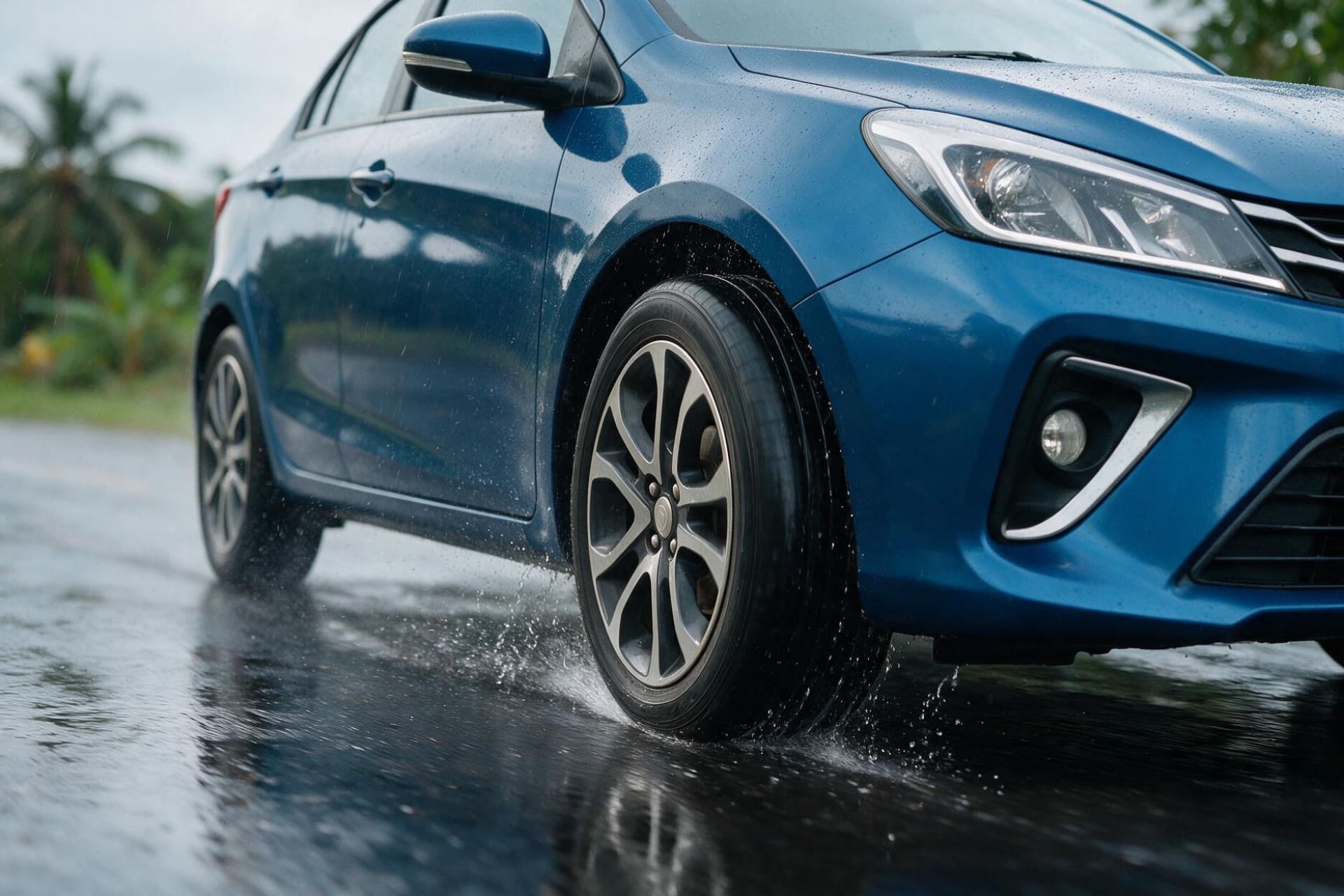
Wet weather driving is the skill of controlling a vehicle safely when rain reduces grip, lengthens stopping distances and cuts visibility. The core habits are simple: slow down, leave more space, brake gently and keep your tyres and wipers in good shape.
Malaysia sees some of the heaviest rainfall in the region, so knowing how to drive in a downpour is a year-round necessity rather than a seasonal one. This guide explains why wet roads are so dangerous, how to adjust your driving, how to recover from a skid or hydroplane, and what to do when flooding turns a road into a hazard.
Why Wet Roads Are So Much More Dangerous
Rain changes the physics of driving before you even notice it. Water sits between your tyres and the road surface, so the friction that normally keeps you moving and stopping in a straight line drops sharply. Less grip is the root cause of almost every wet-weather incident, and it worsens the moment speed climbs.
Stopping distances stretch out as a direct result. On a dry road a car can shed speed quickly, but on a wet surface the same brake pressure needs far more road to bring the vehicle to rest, which is why tailgating becomes so risky in the rain. Wet pavement is a factor in a large share of weather-related crashes, and slower reactions plus longer braking are the mechanism behind that pattern, with research showing that wet pavement contributes to well over a million traffic crashes each year.
Visibility drops at the same time that grip does. Heavy rain, spray thrown up by other vehicles and a misted windscreen all shrink how far ahead you can see, which shortens the time you have to react to a hazard. Reduced visibility compounds the grip problem, because you spot dangers later and then need more distance to respond to them.
Hydroplaning is the extreme version of lost grip. It happens when a wedge of water builds up under the tyre and lifts it clear of the road, so the wheel is effectively skating on a film of water with no steering or braking effect at all. Because water builds up under the contact patch and causes the tyre to lose adhesion with the road surface, even a confident driver can suddenly find the car unresponsive.
How to Adjust Your Driving in the Rain
The single most effective adjustment is to slow down. A widely taught rule of thumb is to cut your speed by about a third on wet roads, so reducing a 70 limit to roughly 47 gives the tyres a realistic chance to clear water and keep you in control. Lower speed buys back the grip and reaction time that the rain took away.
Increasing your following distance is the next priority. Because braking takes longer on wet tarmac, the gap that felt safe in the dry is now too short, so extend it to give yourself room to stop without slamming the pedal. A larger buffer also keeps you out of the heavy spray thrown up by the vehicle ahead, which improves how far you can see.
Braking technique matters just as much as spacing. Brake smoothly and early rather than late and hard, because a sudden stab at the pedal can unsettle a car that already has limited grip. Reading the road further ahead lets you ease off the accelerator in good time, so the brakes do gentle work instead of emergency work.
A few habits round out safer wet weather driving in the following situations:
- Avoid cruise control in the rain, since the system can keep power on at the wrong moment and make a skid or hydroplane harder to correct.
- Steer clear of standing puddles, which can hide deep potholes and also raise the risk of hydroplaning.
- Keep to the middle lanes where you can, because water tends to pool along the edges of the road and the crown of the lane usually drains better.
For a sense of how much your tyres are being asked to do, it helps to understand why adequate tread depth is what channels water away from the contact patch. The deeper the grooves, the more water they can move, and the later hydroplaning sets in.
How to Handle a Skid or Hydroplane
Recovering from a loss of grip is mostly about doing less, not more. The instinct to brake hard or wrench the wheel is exactly what turns a brief slide into a spin, so the goal is to stay calm and let the tyres find the road again.
Ease off the accelerator first. Lifting your foot gently lets the car slow on its own and gives the tyres a chance to bite, whereas keeping the power on prolongs the slide. This is the primary move whether you feel the back end stepping out or the steering going light.
Keep steering in the direction you want to go and hold the wheel steady. Sudden jerks change the tyres’ grip abruptly and can flip a manageable slide into a genuine loss of control. Smooth, minimal steering inputs keep the car predictable while grip returns.
Do not slam the brakes during a hydroplane. Because the tyres are riding on water rather than tarmac, hard braking has almost no effect and can lock a wheel, which is why the RAC advises that easing off the accelerator without braking lets your speed fall until the steering regains its normal weight. Once you feel the tyres reconnect with the road, you can gently resume normal control.
Visibility and Vehicle Readiness Before the Rain
Being seen is half of staying safe in a downpour. Switch on your low-beam headlights rather than high beams, because high beams reflect off the rain and spray and can actually reduce how much you see while dazzling oncoming drivers. Dipped headlights make your car visible to others without blinding anyone.
A clear windscreen is the other half. Working wipers and a functioning demister keep the glass clear of both rain and the internal misting that builds up in humid, wet conditions, so replace any wiper blade that streaks or smears instead of wiping cleanly. Running the air conditioning helps clear a fogged windscreen quickly.
Your tyres do the quiet work of holding the road, and they can only channel water if they are in good condition. Adequate tread depth and the correct pressure are what let the grooves pump water out from under the contact patch, and keeping tyres at the optimal air pressure the carmaker recommends protects both grip and even wear. Because tyres become far more likely to aquaplane once tread falls below about 3mm, the safety margin shrinks long before the legal limit. If yours are close to the wear indicators, it is worth knowing the signs that tell you when to change your car tyres before the next wet season.
Driving Through Floods and Torrential Rain
Flooding calls for a different mindset from ordinary rain, because the danger is no longer about grip but about the water itself. Never attempt to cross fast-moving or deep water, since even a modest current can float a car and sweep it off the road, and standing water can be far deeper than it looks. When in doubt, the safest choice is to turn around and find another route.
Judging depth is difficult from behind the wheel, so err firmly on the side of caution. As a general guide, drivers are warned that deep or fast-flowing floodwater should never be driven into because a vehicle can easily be swept away. Turning back costs you minutes, while getting stranded in rising water can cost far more.
Sometimes the smartest move is simply to stop. When rain becomes torrential and visibility collapses, pulling into a safe rest stop and waiting it out is far wiser than crawling along blind. A short pause lets the worst of the storm pass and lets other drivers thin out too.
Wet Weather Driving in Malaysia: The Monsoon Factor
Malaysia’s climate turns wet weather driving into a core skill rather than an occasional one. Sudden, intense downpours can arrive with little warning and dump enough water in minutes to overwhelm drains, so a dry road can become a hazard almost instantly. Flash floods follow the same pattern, appearing quickly on low-lying roads and underpasses.
The East Coast monsoon adds a seasonal layer to this. States such as Kelantan, Terengganu and Pahang see prolonged heavy rain and widespread flooding during the northeast monsoon months, and road-safety researchers note that rain ranks as a significant causative factor in Malaysian road accidents, second only to fine weather. That statistic is a direct reminder that grip, spacing and speed control are not optional on local roads.
Long-distance journeys deserve special planning during the rainy season. Malaysia’s highways are dotted with R&R stops, and these rest areas are the ideal place to wait out a violent squall rather than pressing on through it. Treating an R&R as a planned safety pause, not just a toilet break, is one of the simplest ways to lower your risk on a wet expressway.
Frequently Asked Questions About Wet Weather Driving
How much should I slow down when driving in the rain?
A common rule is to cut your speed by roughly a third on wet roads. If the limit is 90km/h, easing back to around 60km/h gives your tyres more time to clear water and gives you more time to react. In heavy rain or standing water, slow down even further.
What should I do if my car starts to hydroplane?
Ease your foot off the accelerator, keep the steering wheel pointed straight and do not slam the brakes or jerk the wheel. The car will gradually slow and the tyres will regain contact with the road, at which point you can gently resume normal control. Sudden inputs are what turn a hydroplane into a spin.
Should I use high beams in heavy rain?
No. High beams reflect off the rain and spray and reduce your visibility while dazzling other drivers. Use low-beam headlights so you can see the road and other motorists can see you.
How do tyres affect wet weather safety?
Tyres are your only contact with the road, and their tread grooves channel water away so the rubber can grip. Adequate tread depth and correct air pressure let the tyre pump water out from under the contact patch, while worn or under-inflated tyres hydroplane far sooner. Checking both regularly is one of the most important wet-weather precautions.
Is it safe to drive through a flooded road?
Not if the water is deep or fast-moving. Even shallow-looking floodwater can hide potholes, stall your engine or sweep a car away, so the safest response is to turn around and find another route. If rain is torrential and visibility is gone, wait it out at a safe rest stop.
Grip You Can Trust When the Rain Comes: The Yokohama Advantage
Every wet-weather habit above depends on one thing working properly beneath you: the tyre pressing water off the road and finding grip. That is precisely where the right rubber earns its keep, and it is where Yokohama has built its name over more than a century.
Yokohama is an award-winning Japanese tyre brand founded in 1917, and it holds the distinction of being the first Japanese tyre maker to earn ISO 9001 quality certification, a pedigree that speaks to consistent engineering across every tyre it builds. Its range is organised into three purpose-built lines, each suited to different wet-weather needs: the performance-focused ADVAN range for sharp, responsive handling, the tough GEOLANDAR range for SUVs and off-road capable vehicles, and the fuel-efficient BluEarth range engineered for everyday economy and comfort. Backing the rubber is the We Care Road Hazard Warranty, along with authorised dealers nationwide and the assurance that Yokohama Tyre Sales Malaysia is the sole official importer, so buyers across the country get genuine tyres and proper support.
When the monsoon rolls in and the road turns to a sheet of water, the tread channelling that spray away is doing the hardest work of your journey. Fit tyres engineered to clear water and hold the line, find your nearest authorised dealer, and make wet weather driving safer with Yokohama.
Sources
- AAA Exchange – Wet Weather Driving Tips
- RAC Drive – Advice for Driving in Heavy Rain and Floods
- TyreSafe – What Is Aquaplaning and Hydroplaning?
- NHTSA – Tire Safety Ratings and Awareness (TireWise)
- Malaysian Institute of Road Safety Research – MIROS Road Safety Research
- Paul Tan’s Automotive News – Hydroplaning, or How to Drive in the Rain in Malaysia