
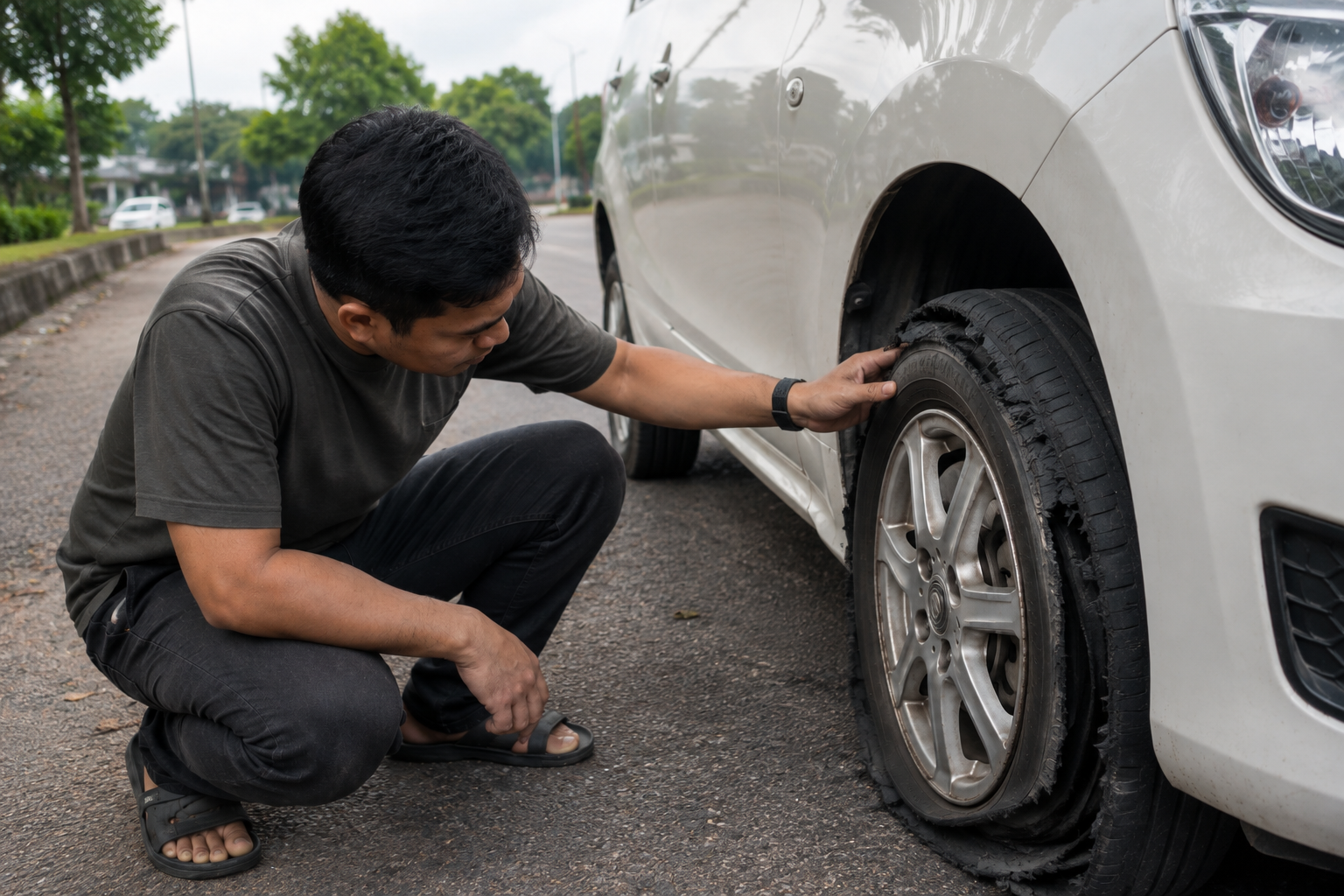
A tyre blowout is a sudden, rapid loss of air pressure in a tyre that can cause a driver to lose control of the vehicle. It usually happens without warning, most often at speed, and the way you react in the first few seconds matters more than almost anything else.
If you drive on Malaysian roads, understanding a blowout is worth a few minutes of your time. This guide explains what a blowout feels like, what to do in the correct order, why it happens, and how to reduce the chance of it ever happening to you. The advice here is deliberately calm and practical, because panic is the one response that makes a blowout far more dangerous than it needs to be.
What Is a Tyre Blowout?
A tyre blowout is the near-instant failure of a tyre, releasing its air in a fraction of a second. Unlike a slow puncture, which lets air escape gradually over minutes or hours, a blowout dumps pressure all at once. The tyre can no longer support the corner of the car it sits under, so the vehicle’s balance and steering change suddenly.
The failure is usually structural. Heat, flexing, and stress cause the layers inside the tyre to separate or the sidewall to rupture, and the casing lets go. Because so much happens in an instant, most drivers describe a blowout as something that “just happened” before they understood what was going on.
What Does a Tyre Blowout Feel Like?
A blowout announces itself in ways you can hear and feel. Knowing the signs in advance helps you identify what is happening and respond correctly instead of freezing.
The first clue is often sound. Many drivers report a loud bang or pop, sometimes followed by a rhythmic flapping or thudding as the shredded tyre slaps against the road and wheel arch. That noise alone can be startling, which is exactly why staying calm is the first skill to practise.
Next comes the pull. The car will suddenly drag hard toward the side of the failed tyre, and the steering may feel heavy or wander. A front tyre blowout is felt most in the steering wheel, while a rear blowout is felt more through the seat and the body of the car, causing the back end to feel loose or to sway. In both cases the vehicle slows abruptly as the flat tyre creates enormous drag.
What To Do During a Tyre Blowout
The correct response to a blowout is counter-intuitive, which is why so many drivers get it wrong. Your instinct will be to brake hard and steer away from the pull. Both instincts are dangerous. Follow these steps in order instead.
Do Not Slam the Brakes
Hard braking is the single worst thing you can do. Slamming the brakes shifts the car’s weight forward and unbalances a vehicle that is already unstable, and it can throw you into a spin. Keeping the vehicle balanced and controllable is the goal, and any overreaction, whether stamping on the brake or snapping your foot off the accelerator, can cause a loss of control, which is why official guidance on surviving a blowout tells drivers not to panic.
Grip the Wheel and Keep Steering Straight
Hold the steering wheel firmly with both hands and keep the car pointed straight ahead. The car will try to pull toward the blown tyre, so make small, smooth corrections to hold your line. Do not wrench the wheel the other way to fight the pull, because over-correcting is a common cause of losing control after the tyre has already failed. Look where you want the car to go, and steer gently in that direction.
Ease Off the Accelerator Gradually
Lift your foot off the accelerator slowly rather than lifting it all at once. The advice from motoring bodies on handling a tyre that blows at speed is to avoid harsh braking entirely and instead let the car scrub off speed on its own. Some drivers briefly hold a light, steady throttle for a second to keep the car stable and moving straight before easing off, since the drag from the ruined tyre is already slowing you quickly.
Let the Car Slow Naturally
Allow friction and the flat tyre’s drag to bring your speed down. As the car slows to a walking pace and feels stable again, you can begin to brake very gently if you still need to. The order matters: regain control first, shed speed second, and stop last.
Pull Over Safely With Hazard Lights On
Once the car is slow and steady, signal, switch on your hazard lights, and steer smoothly onto the shoulder or into a safe lay-by, well clear of moving traffic. On an expressway, use the emergency lane and stop as far to the left as you can. Exit the car on the side away from traffic, stand behind the barrier, and call for assistance rather than attempting a roadside change beside fast-moving vehicles.
What Causes a Tyre Blowout?
Blowouts are rarely random. They almost always trace back to a condition that was building for a while, which is good news, because most of those conditions are avoidable. Understanding the causes is the bridge between reacting to a blowout and preventing one.
Under-Inflation and Heat Build-Up
Under-inflation is the leading cause of blowouts. A tyre with too little air flexes far more than it should as it rolls, and that constant flexing generates heat. The connection between prolonged under-inflation and a catastrophic failure or blowout is strongest on high-speed journeys, where heat builds fastest. As temperature climbs, the rubber and the internal structure weaken until the casing gives way. Keeping the right pressure is the simplest defence, and it helps to understand why correct air pressure protects your tyres.
Overloading Beyond the Vehicle Limit
Every vehicle has a maximum load rating, and every tyre has one too. Carrying more weight than the tyre is designed for forces it to flex and heat up in the same way under-inflation does. Overloading is a common cause of failure on packed family cars, and it compounds any pressure problem that is already present.
Impact Damage From Potholes and Kerbs
A sharp impact can injure a tyre in an instant even if it does not fail on the spot. Hitting a pothole hard or scraping a kerb can crush the tyre against the wheel and damage the internal structure, sometimes leaving a weak spot that fails days or weeks later. A visible bulge on the sidewall is a warning sign of internal damage, and it helps to know what a tyre bulge is and whether it is safe to drive on.
Worn, Aged or Cracked Tyres
Tyres wear out and they also age. Thin tread offers less protection over the casing, and old rubber grows brittle and cracked whether the car is driven often or not. As tyres age they become more prone to failure, and some manufacturers advise replacing tyres that are six to ten years old regardless of tread, a point reinforced by safety guidance on tyre ageing and when to stop using a tyre. Knowing when to change your car tyres removes a lot of this risk.
How To Prevent a Tyre Blowout
Prevention is mostly a matter of routine. A few minutes of attention each month removes the conditions that lead to almost every blowout, and none of it requires special tools.
Check your tyre pressure at least once a month and before any long trip, always when the tyres are cold. Use the figure on the placard inside the driver’s door or in the owner’s manual, not the number moulded on the tyre itself. Correct pressure is the foundation everything else rests on, which is why under-inflation makes a blowout far more likely.
Inspect tread and condition while you are checking pressure. Look for uneven wear, cuts, cracks, embedded objects and bulges, and confirm there is enough tread left to grip and protect the casing. In Malaysia the minimum legal tread depth for commercial vehicles is 1.6 millimetres across the entire contact surface of the tyre, and 1.6 millimetres is a sensible floor for private cars too. If you are unsure, learning to check your tread depth properly takes only a moment.
Do not overload the vehicle. Respect the load rating, distribute weight sensibly, and add a little pressure when carrying a full load if the manual advises it. Heed your Tyre Pressure Monitoring System, or TPMS, which is the dashboard warning that lights when a tyre is significantly low. The system is designed to alert you once pressure falls roughly 25 percent below the recommended level, so a lit warning means act soon, not eventually. Finally, replace tyres that are aged, cracked or damaged before they fail, because monthly checks of pressure, tread and damage catch problems while they are still cheap to fix.
Tyre Blowouts on Malaysian Roads
Malaysian driving conditions add their own pressures, and it is worth naming them. Long stretches of expressway invite sustained high speed, which is precisely when heat builds fastest in an under-inflated or overloaded tyre and turns a small fault into a blowout.
The tropical heat compounds it. Hot ambient temperatures and hot road surfaces mean a tyre is already running warm before you add the heat of flexing, leaving less margin before the casing is stressed beyond its limit. After the monsoon, potholes open up across many routes, and a hard hit at speed can damage a tyre’s structure in a way you may not notice until later.
Balik kampung season brings the final ingredient. Cars are loaded with passengers, luggage and gifts, often to the limit and sometimes beyond it, then driven for hours at expressway speed in the heat. That combination of load, speed and temperature is exactly the recipe a blowout needs, which is why a pressure and condition check before a long festive drive is one of the most valuable habits a Malaysian driver can build.
Frequently Asked Questions About Tyre Blowouts
What is the first thing to do in a tyre blowout?
Grip the steering wheel firmly with both hands and keep the car pointed straight ahead. Do not brake hard and do not jerk the wheel. Regaining control comes first, and slowing down comes after the car is stable.
Should you brake during a tyre blowout?
Not at first. Hard braking unbalances an already unstable car and can cause a spin. Ease off the accelerator, let the car slow on its own, and only brake gently once you are down to a low, steady speed.
What is the difference between a front and a rear tyre blowout?
The correct response is the same for both, but they feel different. A front blowout is felt mainly through the steering, while a rear blowout is felt more in the seat and the body of the car, often as a sway from the back.
Can you prevent a tyre blowout?
Most blowouts are preventable. Keeping correct pressure, checking tread and condition monthly, not overloading the vehicle, heeding the TPMS warning and replacing aged or damaged tyres removes the conditions that cause the great majority of failures.
How does hot weather affect tyre blowout risk?
Heat raises the risk because it weakens rubber and the internal structure. In a hot climate a tyre already runs warm, so under-inflation or overloading pushes it past its safe limit faster than it would in a cool one.
Trusted Tyres That Reduce Your Risk on the Road
Good driving habits prevent most blowouts, and the tyre itself is the other half of the equation. A well-made tyre resists heat, holds its structure under load and gives you margin when conditions turn against you, which is exactly what you want standing between your car and a Malaysian expressway.
Yokohama is an award-winning Japanese tyre brand that has built tyres since 1917, and it was the first Japanese tyre maker to earn ISO 9001 certification, a mark of consistent manufacturing quality. Its range in Malaysia is built around three lines, each engineered for a purpose: the performance-focused ADVAN range, the tough GEOLANDAR range for SUVs and light trucks, and the fuel-efficient BluEarth range for everyday driving. Every Yokohama tyre is backed by the We Care Road Hazard Warranty, which covers non-repairable damage from road hazards, and is sold through authorised dealers nationwide, supplied by the sole official importer, Yokohama Tyre Sales Malaysia.
Fitting quality tyres and keeping them properly maintained is the surest way to keep a blowout from ever entering your day. To find the right fit for your car and drive with genuine peace of mind, explore the full range at Yokohama Tyre Malaysia.
Sources
- National Highway Traffic Safety Administration – Tires (TireWise)
- National Highway Traffic Safety Administration – Tire Pressure Monitoring System, FMVSS No. 138
- TyreSafe – Discover Your Correct Car Tyre Pressure
- RAC – How To Repair a Tyre in Simple Steps
- U.S. Tire Manufacturers Association – Tire Care & Safety
- Paul Tan’s Automotive News – Minimum 1.6 mm Tread Depth Across Entire Tyre Surface a Must for All Commercial Vehicles, JPJ