
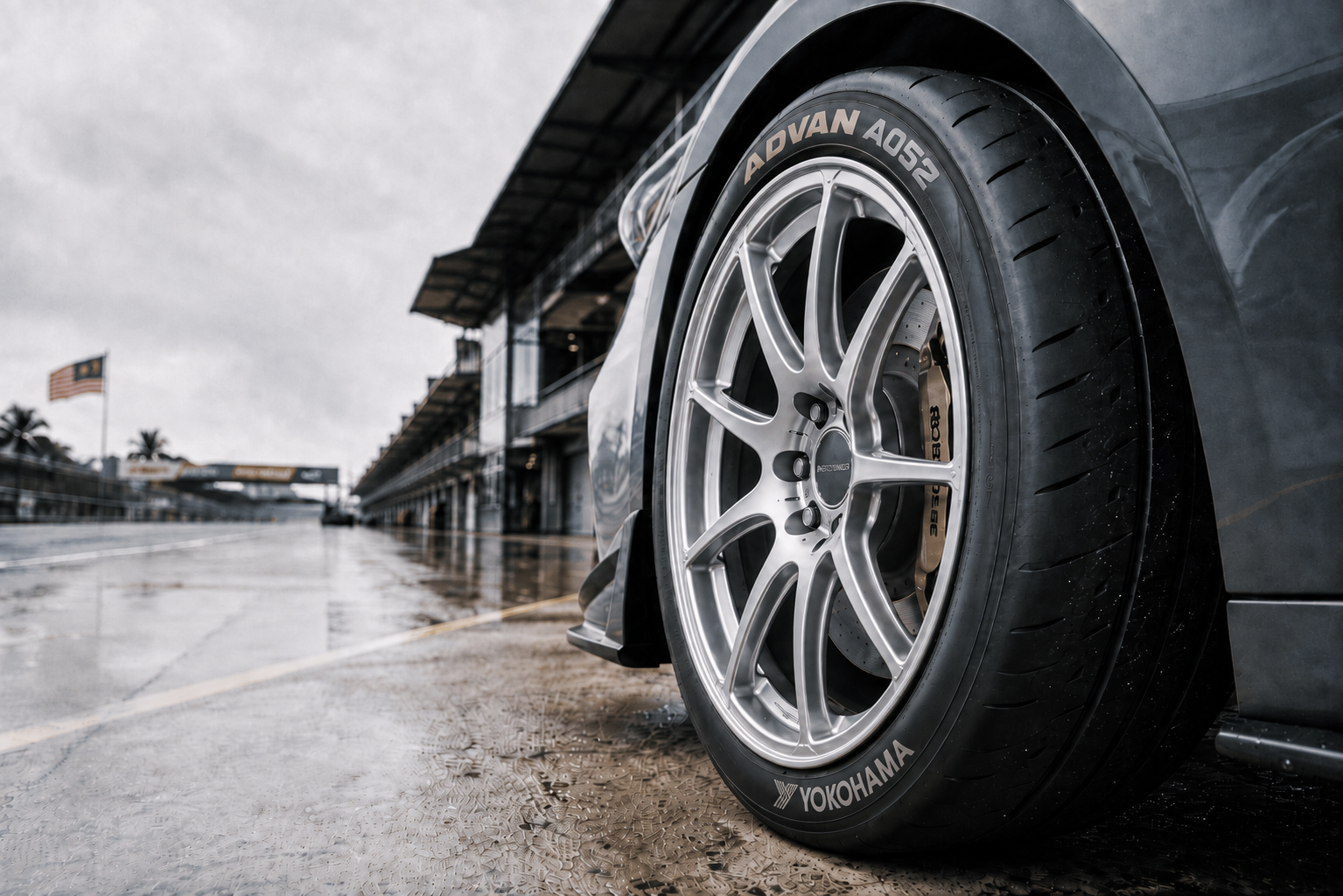
Semi slick tyres are high-performance tyres built with a minimal tread pattern that places far more rubber on the road than an ordinary tyre, sitting halfway between a full racing slick and a regular road tyre. They trade some wet-weather and tread-life margin for sharper dry grip, which makes them a favourite for track days and spirited driving in Malaysia.
The appeal is easy to understand once you see one. A semi slick looks almost bald next to a normal tyre, with only a few wide grooves breaking up a large, smooth contact area. That design choice is the whole point, and it is also the reason these tyres come with real trade-offs that every Malaysian driver should weigh before buying. This guide explains what semi slick tyres are, how they differ from other tyres, where they shine, and where the local climate complicates things.
What Are Semi Slick Tyres?
Semi slick tyres are road-legal performance tyres with a reduced tread pattern designed to maximise grip on dry tarmac. The name comes from the racing slick, a competition tyre with a completely smooth surface. A semi slick keeps a handful of grooves so it can still shift some water and meet road rules, while borrowing the slick’s large rubber-to-road contact area.
To understand the category, it helps to picture a spectrum. At one end sits the full slick, and at the other sits the everyday touring tyre. The semi slick lives in the middle, closer to the slick on dry grip and closer to the road tyre on usability. Because of this in-between nature, semi slicks are sometimes labelled “track day” or “extreme performance” tyres rather than pure competition rubber.
This positioning matters because it sets expectations. A semi slick will not match a touring tyre for comfort, quiet, or wet safety, and it will not match a full slick on a dry circuit. What it offers instead is a usable blend, and the value of that blend depends entirely on how and where you drive.
How Semi Slicks Differ From Full Slicks
The clearest difference is tread, and tread changes everything. A racing slick has a smooth surface with no grooves, which gives it the largest possible contact patch and the maximum dry traction for its size. That same smoothness is its weakness, because a slick has no channels to push water away and will aquaplane at much lower speeds and in shallower puddles than a treaded tyre.
Semi slicks soften that compromise. By cutting a few wide grooves into the rubber, they retain a way to disperse standing water, which a full slick simply cannot do. The result is a tyre you can legally fit to a car and drive to the circuit, rather than one that must be trailered there.
Full slicks also depend on heat. They are built from soft compounds that only reach peak grip once warmed to racing temperature, which is impractical on public roads. Semi slicks use compounds that work across a wider temperature window, so they are more forgiving in normal use even if they still prefer to be warm.
How Semi Slicks Differ From Regular Road Tyres
Regular road tyres are designed to do many jobs adequately, and tread is how they manage that range. A touring or all-season tyre carries deep, intricate tread patterns that channel water, grip in the wet, resist wear, and stay quiet at highway speed. All that tread, however, reduces the amount of rubber touching the road at any moment.
Semi slicks invert those priorities. With shallower, sparser tread, more of the contact patch stays planted on the surface, which sharpens steering response and raises cornering grip in the dry. The give-back is everything the deep tread was providing, namely longevity, refinement, and wet security.
So the difference is one of intent. A road tyre is optimised for the daily commute across all conditions, while a semi slick is optimised for the few minutes of hard driving where outright grip decides the outcome. If you are still mapping out which category suits you, the broader guide to choosing the right car tyres is a useful starting point.
Minimal Tread for Maximum Dry Grip
The defining benefit of a semi slick is dry grip, and the mechanism is contact area. Grip on a dry surface is broadly a function of how much rubber meets the road, so removing tread grooves frees up more of the tyre face to do useful work. This is exactly why competition tyres trend toward smooth surfaces in the first place.
That extra contact translates into tangible behaviour on a dry circuit. Turn-in feels sharper, the car holds higher cornering speeds before the tyre lets go, and braking distances tighten because there is more rubber resisting the road. For a driver chasing lap times, these gains are the entire reason to fit semi slicks.
Compound plays a supporting role alongside the tread. Performance semi slicks typically use stickier rubber that keys into the tarmac, and they reward heat built up through hard driving. Crucially, that same stickiness wears faster and struggles in the cold and wet, which is why the dry-grip advantage is not free.
Track Days and Spirited Road Use
Semi slick tyres earn their keep on the track, where their strengths line up with the demands of the environment. A circuit is dry far more often than not, the surface is consistent, and the priority is grip rather than comfort or mileage. In that setting the tyre’s minimal tread becomes a clear advantage instead of a liability.
Spirited road driving is the secondary use case, and here the picture is more nuanced. On a dry mountain road or a clear early-morning run, a semi slick rewards a keen driver with feedback and bite that a touring tyre cannot match. Many enthusiasts in Malaysia run them precisely for these moments, treating the daily compromises as a price worth paying.
The honest caveat is that most Malaysian roads are not race tracks. Traffic, broken surfaces, and sudden downpours all blunt the semi slick’s advantages and expose its weaknesses. The tyre makes most sense when track or canyon driving is a genuine part of your routine, not an occasional novelty.
The Wet-Weather and Tread-Life Trade-Offs in Malaysia
Wet weather is where semi slick tyres ask the most of a Malaysian driver. Tread grooves exist to channel water out from under the tyre, and insufficient tread depth significantly raises the risk of hydroplaning, the dangerous moment when a film of water lifts the tyre off the road. A semi slick has less tread to begin with, so it reaches that limit sooner than a regular tyre.
This is a serious consideration given the local climate. Malaysia sits in a tropical zone with copious year-round rainfall, with mean annual rainfall of roughly 2,540 mm and rain falling on 150 to 200 days a year across much of the country. Sudden, heavy afternoon storms are routine rather than rare, which means a semi slick will meet standing water far more often here than in a drier market.
The numbers around wet braking make the stakes concrete. A pickup at 70 mph with worn 2/32-inch tread can need up to 499.5 feet to stop on wet pavement, around 122 feet more than the same vehicle with 4/32 inch of tread. Tread depth, in other words, has a direct say in whether you stop in time.
Tread life is the other trade-off, and it follows from the same design. The soft, grippy compounds that make semi slicks fast also wear quickly, especially under the hard cornering and braking they invite. A set used regularly on track can wear out in a fraction of the mileage you would expect from a touring tyre, so the running cost is higher than the purchase price alone suggests. Keeping an eye on wear matters even more here, and the tread depth check guide explains how to monitor it.
Road Legality and Tread Depth in Malaysia
Most semi slick tyres are road legal, but legality hinges on tread depth, so the law deserves a clear read. In Malaysia the Road Transport Department, known as JPJ, enforces a minimum tread depth of 1.6 mm, and now requires that 1.6 mm be present across the entire contact surface of the tyre for commercial vehicles, a tighter standard than the previous rule that allowed shallower wear over part of the surface.
For a semi slick, this rule has two practical edges. First, a new semi slick must carry a tread pattern deep enough to clear the legal minimum, which is why genuinely road-legal options keep those few defining grooves rather than running fully smooth. Second, because a semi slick starts with less tread, it has less room to wear before it drops below the legal line, so it reaches the point of replacement sooner.
There is also a safety margin to respect beyond the bare legal figure. Tyre and road-safety bodies commonly advise replacing tyres before they hit 1.6 mm, since wet grip falls off well above that point. Treat 1.6 mm as the absolute floor, not a target, and plan to change semi slicks earlier if you rely on them in the rain.
Who Should Buy Semi Slick Tyres?
Semi slick tyres suit a specific driver rather than the general motorist. The clearest fit is the track-day enthusiast who wants competitive grip from a tyre that can still be driven to and from the circuit legally. For this person the wear rate and wet compromise are understood and accepted.
A second group is the committed weekend driver whose car sees regular hard use on dry roads and who keeps a separate set of tyres or a second car for everyday duties. The flexibility to swap onto something more sensible when the monsoon arrives makes the ownership far more practical.
Semi slicks are a poor fit, however, for the daily commuter who needs one set of tyres to handle every condition. If your driving is mostly city traffic, highway cruising, and school runs through frequent rain, the safety and longevity of a quality road tyre will serve you better. Matching the tyre to your real driving pattern, not your aspirations, is the decision that keeps you both quick and safe.
How to Care for Semi Slick Tyres
Caring for semi slick tyres extends their short life and keeps them safe, and it starts with pressure. Correct inflation lets the contact patch sit flat on the road as designed, while the wrong pressure distorts it and accelerates uneven wear, with pressure, tread, rotation, and alignment forming the four pillars of ongoing tyre care. Check pressures cold and to the figure your car maker specifies.
Heat management is the next priority, because these tyres are sensitive to temperature. Bring them up to working temperature gradually rather than attacking the first corner hard, and give them time to cool between hard sessions to avoid overheating the compound. Storing them away from direct sunlight and ozone sources also slows the ageing of the rubber.
Finally, inspect them often and rotate them to even out wear. Look for the grooves wearing toward the 1.6 mm legal limit, and watch for damage that a low-profile performance tyre can pick up from kerbs and potholes. Worn tyres are significantly more likely to be involved in a crash than tyres with healthy tread, so disciplined inspection is not optional on a tyre that wears as fast as a semi slick.
Built for the Corner: The Yokohama Performance Pedigree
Choosing a performance tyre is ultimately a question of trust, because the rubber is the only thing connecting your car to the road when you are pushing hard. That trust is best placed in a maker with a long engineering record. Yokohama is an award-winning Japanese tyre brand established in 1917, and it was the first Japanese tyre maker to earn ISO 9001 certification, a globally recognised standard for quality management.
Yokohama channels that heritage into three distinct product lines, each aimed at a clear purpose. The performance-focused ADVAN range is the natural home for drivers exploring the semi slick world, with motorsport-bred options such as the track-oriented ADVAN A052 and the road-and-track ADVAN NEOVA AD09. Alongside ADVAN sit the GEOLANDAR line for SUVs and light trucks and the BluEarth line for fuel-efficient everyday driving, so the same brand can cover both your track set and your daily set.
Buying with confidence is the final piece. Yokohama tyres in Malaysia are backed by the We Care Road Hazard Warranty and supported by authorised dealers nationwide, with Yokohama Tyre Sales Malaysia serving as the sole official importer. When you are ready to put proper performance rubber under your car, explore the full range from Yokohama.
Frequently Asked Questions
Are semi slick tyres road legal in Malaysia?
Most semi slick tyres are road legal in Malaysia as long as they meet the JPJ minimum tread depth of 1.6 mm across the contact surface. Always confirm a specific tyre is approved for road use rather than marked for competition only, and replace it before the tread drops to the legal floor.
Are semi slick tyres safe in the rain?
Semi slick tyres are usable in light rain but carry a higher hydroplaning risk than regular tyres because they have less tread to channel water away. Given Malaysia’s frequent heavy downpours, drivers should slow down considerably in the wet and avoid semi slicks entirely if rain is a regular part of their commute.
How long do semi slick tyres last?
Semi slick tyres wear faster than touring tyres because of their soft, grippy compounds and reduced tread. Used hard on track, a set can wear out in a fraction of the mileage of a normal tyre, so their lifespan depends heavily on how aggressively and how often they are driven.
Can I use semi slick tyres as my daily tyres?
You can, but it is rarely a good idea for a single-set daily driver in Malaysia. The faster wear, weaker wet grip, and reduced refinement make them a costly and less safe choice for commuting, and most owners run them alongside a separate set of everyday tyres.
What is the difference between semi slick and slick tyres?
A slick tyre is a fully smooth competition tyre with no grooves and no ability to clear water, making it illegal and unsafe on public roads. A semi slick keeps a few grooves so it can shift some water and meet road rules, trading a little dry grip for real-world usability.
Sources
- National Highway Traffic Safety Administration – Tire Safety Ratings and Awareness, TireWise
- U.S. Tire Manufacturers Association – Tire Care & Safety
- Paul Tan’s Automotive News – Minimum 1.6 mm tread depth across entire tyre surface a must for all commercial vehicles, JPJ
- Britannica – Climate of Malaysia
- Yokohama Tyre Malaysia – Home