
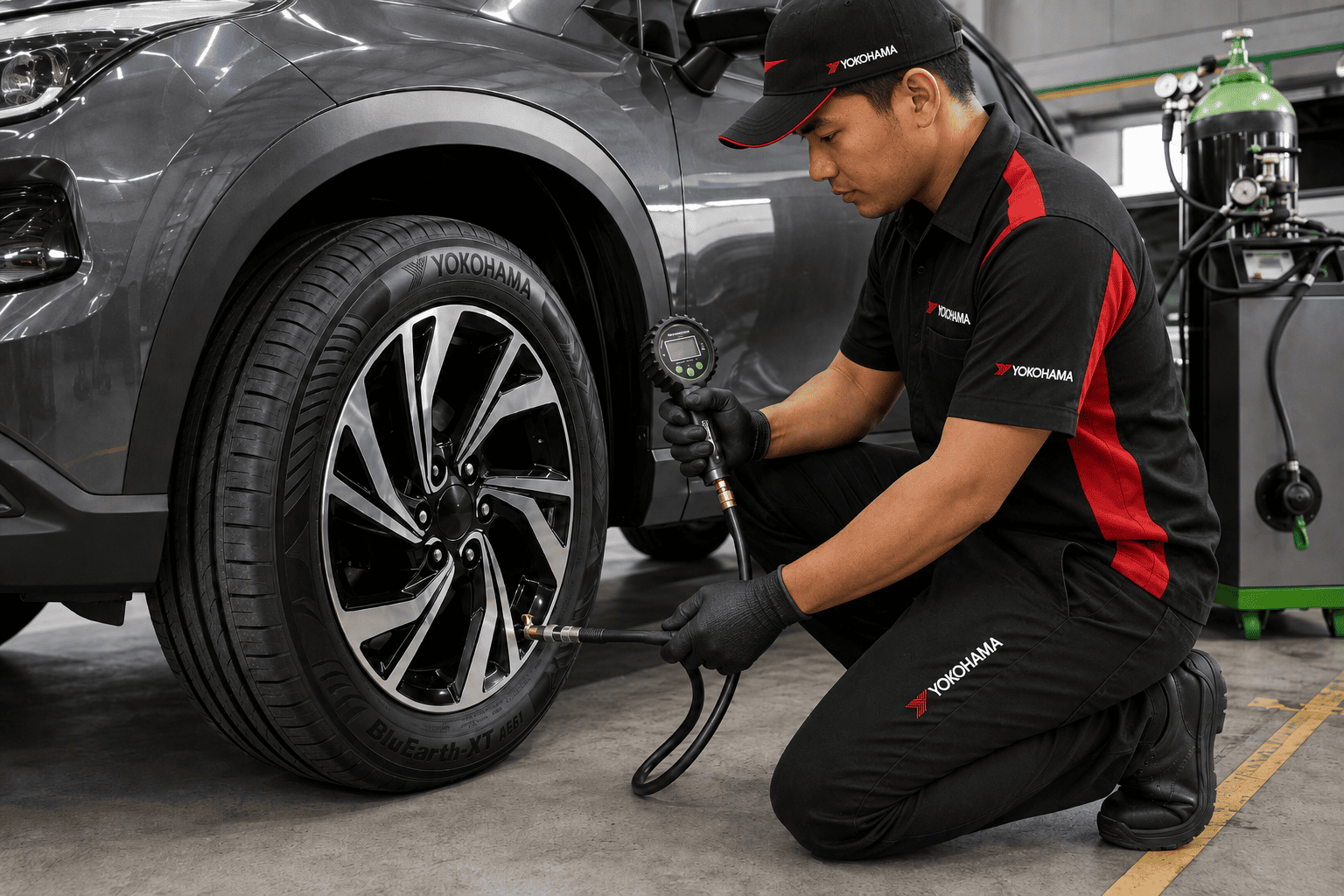
A nitrogen tyre is simply an ordinary tyre inflated with purified nitrogen gas instead of the compressed air pumped from a standard workshop line. The gas itself is not exotic, because the air we breathe is already about 78 percent nitrogen, and nitrogen inflation just filters that air to a much higher purity before it goes into the tyre.
That single fact explains most of the confusion around the topic. Nitrogen inflation does not add anything magical to your tyre; it removes things instead, mainly oxygen and moisture. Below we set out what a nitrogen tyre really does, where the benefits are genuine, where they are oversold, and what actually keeps drivers safe on Malaysian roads.
What Is a Nitrogen Tyre?
A nitrogen tyre is a tyre filled with nitrogen at roughly 93 to 99 percent purity rather than the usual mix of gases in ambient air. Workshops produce this gas with a nitrogen generator that draws in ordinary compressed air and passes it through a membrane or a molecular sieve. The equipment separates out most of the oxygen along with water vapour, leaving a drier, more concentrated stream of nitrogen behind.
The remaining oxygen and moisture are the whole point of the exercise. Oxygen molecules are smaller and more reactive than nitrogen molecules, so they slip through rubber more readily and they promote oxidation inside the tyre and wheel. By stripping most of them out, a nitrogen fill aims to leave a gas that seeps out more slowly and carries far less water.
Crucially, nothing about the tyre casing, tread, or construction changes. A “nitrogen tyre” is the same product you would buy anyway; only the contents of the air chamber differ. That is why the honest question is never whether nitrogen works, but whether the difference is large enough to matter for how you drive.
How Nitrogen Tyre Inflation Is Produced
Nitrogen for tyres starts life as the same compressed air already sitting in a workshop tank. The generator forces that air through a separation membrane that lets the smaller, faster oxygen and water molecules escape while holding back the larger nitrogen molecules. What comes out the other side is a high-purity nitrogen stream, typically in that 93 to 99 percent band once the line has run for a moment.
Before filling, a technician usually deflates the tyre and refills it once or twice to purge the ordinary air already inside. This “flush” matters because a single top-up over existing air only dilutes what is already there. Many shops in Malaysia then fit a green valve cap so the tyre is easy to identify as a nitrogen fill on the next visit.
The process is straightforward, but it is also why nitrogen is less convenient than air. You cannot make high-purity nitrogen at a petrol-station air pump, so a proper top-up means returning to a shop that has the generator.
The Real Benefits of a Nitrogen Tyre
The genuine advantages of a nitrogen tyre come from what has been removed, not added, and they are real but modest. First, nitrogen permeates rubber more slowly than oxygen, so a nitrogen-filled tyre tends to hold its set pressure a little longer between checks. Independent long-term testing has found the gap to be small in everyday use; one twelve-month comparison saw nitrogen tyres lose about 2.2 psi against 3.5 psi for air over the whole year, a difference of only around 1.3 psi.
Second, the drier gas means less water vapour sealed inside the tyre and wheel. Less internal moisture means less pressure swing as the tyre heats and cools, and less scope for corrosion on the wheel and the valve components over a long service life.
Third, that stability under heat is why motorsport teams, aircraft, and heavy-duty operators favour nitrogen. When a tyre runs hot for long stretches, dry nitrogen keeps pressure steadier than moist air, which behaves less predictably as temperature climbs. These are demanding, controlled settings, and they are where the benefit is easiest to see.
If you want to understand why pressure drifts in the first place, our guide on why tyres lose pressure over time sets out the ordinary causes that affect every tyre regardless of the gas inside it.
The Drawbacks and Honest Limits
Against those benefits sit some real costs, and this is where balance matters. The first drawback is price, because nitrogen inflation is a paid service rather than the free air at most stations, and each purge-and-fill adds to the running cost of the tyre.
The second is convenience. Since you cannot top up nitrogen from a normal air pump, a slow leak or a pressure drop on a long trip leaves you choosing between driving to a nitrogen shop or adding plain air and diluting the fill. Neither option is a crisis, but both undercut the tidy promise of a “set and forget” tyre.
The third and most important limit is this: a nitrogen tyre is not a substitute for routine pressure checks. Every tyre loses pressure gradually no matter what it is filled with, so drivers are still advised to check inflation regularly and inspect for damage. Nitrogen slows the drift; it does not stop it, and it cannot detect a nail, a slow puncture, or a valve fault. Correct pressure remains something you confirm with a gauge, not something the gas guarantees.
Can You Mix Nitrogen With Ordinary Air?
Yes, you can safely mix nitrogen with ordinary air in the same tyre, and doing so will not damage anything. Remember that normal air is already mostly nitrogen, so adding air to a nitrogen tyre simply lowers the purity a little rather than causing any reaction or hazard.
The only real consequence is a diluted benefit. If you top up a nitrogen fill with station air a few times, the purity falls and the small advantages fade toward those of an ordinary air-filled tyre. To keep the full effect, you would return to a nitrogen source; to stay safe in the meantime, adding air is completely acceptable. Safety always comes before purity, so never drive on a low tyre just because a nitrogen pump is not nearby.
Does a Nitrogen Tyre Save Fuel or Last Longer?
This is where marketing tends to outrun the evidence, so it is worth being precise. A nitrogen tyre saves fuel and extends tread life only to the extent that it keeps your pressure correct, and correct pressure is the true lever. Keeping tyres inflated to the recommended level can improve fuel economy noticeably, with under-inflation lowering mileage by roughly 0.2 percent for every 1 psi drop across all four tyres.
The point is that air does exactly the same job when the pressure is right. Nitrogen may hold that pressure slightly longer between checks, but it does not have a separate, magic effect on rolling resistance or wear. A driver who checks air-filled tyres monthly will see the same fuel and wear benefits as a nitrogen user who neglects them. If longevity is your goal, tread care matters just as much as pressure, and our guide on how to check your tread depth explains how to monitor it.
The Malaysia Angle: Heat, Habits and Green Caps
Malaysia’s hot, humid climate is often used to argue for nitrogen, and the logic has some merit. High ambient heat and long highway runs raise tyre temperatures, and steadier pressure under heat is exactly where dry nitrogen performs best, so the theory travels well to local conditions. Many workshops around the country now offer nitrogen inflation, usually marked with a green valve cap so the fill is easy to spot.
Even so, the local reality points back to fundamentals. Heat makes correct pressure more important, not less, and the biggest safety risks on Malaysian roads come from worn or under-inflated tyres rather than from the choice of gas. Regulators here have tightened tyre standards accordingly; a rule in force from mid-2025 requires a minimum tread depth of 1.6 mm across the entire contact surface of the tyre for all commercial vehicles, with hundreds failing inspection in the first weeks. That focus on tread and condition is a useful reminder of where attention belongs. For the day-to-day basics, our explainer on setting the optimal air pressure for your tyres covers what to aim for and how to check it.
The Honest Verdict
For everyday driving in Malaysia, correct pressure and good tyre care matter far more than the gas inside your tyres. Nitrogen is not a gimmick and it is not harmful; it offers small, genuine gains in pressure stability and reduced internal moisture, and it earns its place in racing, aviation, and heavy-duty fleets where those gains add up.
For the average commuter, though, the sensible verdict is this. If your workshop offers nitrogen at a price you are comfortable with, there is no reason to refuse it. If it costs more than you want to pay, an air-filled tyre that you check regularly will serve you just as well. Either way, the habit that protects you, your fuel bill, and your tyres is the same one: check pressure often, inspect for damage, and replace tyres before the tread runs low.
Trust Yokohama for Tyres That Perform in Any Climate
Whatever you decide about the gas inside your tyres, the tyre itself is what meets the road, and choosing a maker with a long engineering pedigree matters far more than valve-cap colour. This is where Yokohama earns its reputation in Malaysia. An award-winning Japanese tyre brand founded in 1917, Yokohama was the first Japanese tyre maker to earn ISO 9001 quality certification, a milestone that reflects a century of disciplined manufacturing behind every tyre.
That heritage runs through three purpose-built ranges. The ADVAN performance range is engineered for grip and precise handling, the GEOLANDAR SUV and 4×4 range is built for the demands of larger vehicles and rough terrain, and the BluEarth fuel-efficient range is designed for lower rolling resistance and everyday economy. Every one of them is backed by the Yokohama We Care Road Hazard Warranty and sold through authorised dealers nationwide, with Yokohama Tyre Sales Malaysia as the sole official importer, so you buy with genuine support behind you.
Nitrogen or air, hot highway or city crawl, the smart move is to start with a tyre built to last and to keep it properly maintained. Find the right fit for your car and your driving at Yokohama.
Frequently Asked Questions About Nitrogen Tyres
What is a nitrogen tyre?
A nitrogen tyre is an ordinary tyre inflated with purified nitrogen at around 93 to 99 percent purity instead of standard compressed air. Because air is already about 78 percent nitrogen, the process mainly removes oxygen and moisture rather than adding anything new.
Is a nitrogen tyre worth it in Malaysia?
It can be worth it if the price is reasonable, but it is not essential. The benefits are real but modest, and a well-maintained air-filled tyre performs just as safely, so the value depends on how much you are willing to pay for slightly steadier pressure.
Can I put normal air in a nitrogen tyre?
Yes. Mixing air with nitrogen is completely safe and will not harm the tyre; it only lowers the nitrogen purity and dilutes the small benefit. Never drive on an under-inflated tyre just because a nitrogen pump is unavailable.
Does a nitrogen tyre still lose pressure?
Yes. Every tyre loses pressure gradually regardless of the gas inside, so nitrogen slows the drift but does not stop it. Regular pressure checks remain essential no matter what your tyres are filled with.
Why do nitrogen tyres have green caps?
The green valve cap is a workshop convention that marks a tyre as nitrogen-filled so technicians know to top it up with nitrogen rather than plain air on the next visit. It has no effect on performance and is purely for identification.
Sources
- Consumer Reports – Should You Use Nitrogen in Your Car Tires?
- National Highway Traffic Safety Administration – Tire Safety Ratings and Awareness (TireWise)
- U.S. Department of Energy – Gas Mileage Tips: Keeping Your Vehicle in Shape
- U.S. Tire Manufacturers Association – Tire Care and Safety
- Paul Tan’s Automotive News – Minimum 1.6 mm tread depth across entire tyre surface a must for all commercial vehicles, says JPJ
- Yokohama Tyre Malaysia – Yokohama Tyre Malaysia Official Site