
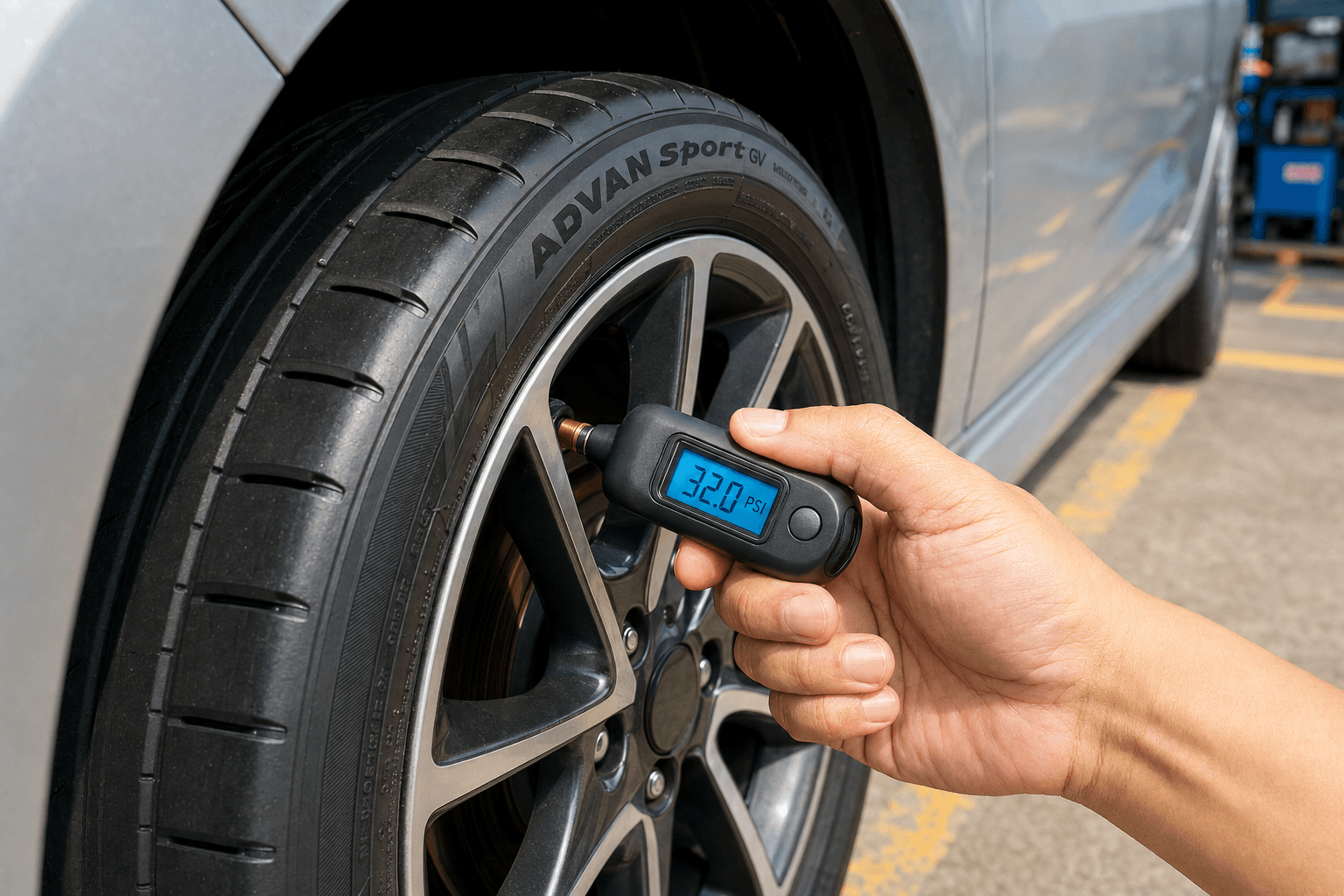
Knowing how to check tire pressure is the single cheapest habit that keeps your car safe, and it takes less than five minutes at any petrol station in Malaysia. Tire pressure is the amount of air inside a tyre, measured in PSI (pounds per square inch) or kPa, and checking it means comparing that reading against the figure your vehicle manufacturer recommends.
Correct pressure is not a luxury detail. It governs how your car grips the road, how far it travels on a tank of fuel, and how long your tyres last. This guide walks through how to check tire pressure the right way, how often to do it, and what your readings are telling you, all in the context of driving in Malaysia.
Why Tire Pressure Matters So Much
Tire pressure is the foundation of everything a tyre does, because the air, not the rubber, carries the weight of your car. When pressure drops, the tyre flexes more than it should, builds up heat, and loses its designed shape against the road.
That heat is the real danger on Malaysian roads. Our climate keeps ambient temperatures high all year, and long highway stretches like the PLUS expressway let heat accumulate over hours of driving. An underinflated tyre running hot is far more likely to suffer a blowout, which is why pressure discipline matters more here than in cooler countries.
The safety stakes are well documented. Even a few PSI below the recommended figure can affect a vehicle’s handling and stopping distance. Crucially, those few PSI are invisible to the eye, so a tyre can look perfectly normal while quietly hurting your braking.
Fuel economy is the everyday cost. Underinflated tyres create more rolling resistance, so the engine works harder and burns more petrol to cover the same distance. Proper inflation can improve fuel economy by about 0.6 percent on average, and up to 3 percent in some cases, while every 1 psi drop across all tyres lowers it by roughly 0.2 percent. In short, soft tyres cost you money at every fill-up.
What Pressure Should Your Tyres Be?
Your correct tire pressure is set by the carmaker, not by the tyre, and it is printed where you can find it in seconds. Look for the tyre placard sticker on the driver’s side door edge or door jamb, and you will also find the figure in your owner’s manual.
That placard number is the target, and it is a cold-tyre figure. The recommended PSI is defined as the pressure when the tyre is cold, meaning the car has not been driven for at least three hours. Most Malaysian passenger cars sit between 30 and 36 PSI, though SUVs and loaded vehicles often need more.
One number on the placard is easy to misread, so check it carefully. Many vehicles list a higher pressure for the rear when the car is fully loaded with passengers or luggage, which is useful for balik kampung trips. To understand the full picture of why this figure is set the way it is, our guide on optimal air pressure explains how manufacturers balance comfort, grip, and load.
Ignore the number moulded into the tyre sidewall for daily use. That figure is the maximum the tyre can hold, not the pressure your car should run, and inflating to it will give you a hard, skittish ride with less grip. Check pressure when the tyres are cold and at least once a month, and set it to the figure on the driver door placard or owner’s manual rather than the maximum on the sidewall.
How to Check Tire Pressure: Step by Step
Checking tire pressure is a short, repeatable routine, and doing it in the same order every time means you never miss a tyre. You will need a tyre pressure gauge, which can be a cheap pen-type unit, a digital gauge, or the air pump found at most petrol stations and tyre shops.
First, check the tyres cold. Park and wait at least three hours after driving, or check first thing in the morning before any trips, because heat from driving raises the reading and gives a falsely high figure.
Second, unscrew the valve cap on the first tyre and keep it somewhere safe. Press the gauge firmly and squarely onto the valve stem until the hissing stops, then read the figure. A brief hiss is normal; a long hiss means the gauge is not seated straight.
Third, compare the reading to your placard figure. If the tyre is low, add air in short bursts and re-check; if it is over, press the small pin inside the valve to release a little air, then re-check. Repeat across all four tyres, and do not forget the spare, since a flat spare is useless in an emergency.
Finally, refit every valve cap. The cap keeps dirt and water out of the valve and acts as a second seal, so a missing cap can slowly cost you pressure over time.
How Often Should You Check Tire Pressure?
Tire pressure should be checked at least once a month, plus before any long journey. Check all tyres, including the spare, monthly and always when they are cold.
Monthly is not arbitrary, because tyres lose air on their own. The same NHTSA guidance notes that tyres naturally leak around 1 PSI per month through the rubber, and lose roughly 1 PSI for every 10 degree Fahrenheit drop in temperature. A tyre can therefore drift well below spec over a few months without any puncture at all.
If you find a tyre that drops faster than the rest, treat it as a warning sign rather than a top-up chore. Persistent pressure loss often points to a slow puncture, a corroded rim, or a failing valve, and our guide on why tyres lose pressure helps you trace the cause before it becomes a roadside problem.
TPMS: Helpful, but Not a Substitute
Many newer cars sold in Malaysia carry a Tyre Pressure Monitoring System, or TPMS, which warns you on the dashboard when pressure falls. TPMS is a genuine safety aid, but it is a backstop, not a replacement for manual checks.
The reason is timing. Most warning systems only trigger once pressure has already fallen significantly below target, by which point grip and fuel economy have suffered for some time. A tyre pressure monitoring system must warn the driver when a tyre is 25 percent or more below the recommended pressure, and under-inflation raises the risk of skidding, longer stopping distances, and blowouts. A monthly gauge check catches the slow drift long before the light ever comes on.
Protect Your Effort With the Right Tyres
Checking pressure faithfully only pays off when the tyre itself is built to hold that pressure and grip Malaysian roads, which is where the quality of the tyre brand becomes decisive. A premium tyre rewards good maintenance with longer life, more stable pressure, and safer braking in the wet.
This is where Yokohama stands apart. Yokohama is an award-winning Japanese tyre brand established in 1917 and the first Japanese tyre maker to earn ISO 9001 certification, a pedigree of quality assurance that translates directly into consistent, dependable tyres. The range covers every kind of Malaysian driver, from the performance-focused ADVAN line, to the rugged GEOLANDAR SUV and off-road range, to the fuel-saving, comfort-oriented BluEarth line.
Buying Yokohama also means buying peace of mind. Every set is backed by the We Care Road Hazard Warranty and supported by authorised dealers nationwide, with Yokohama Tyre Sales Malaysia as the sole official importer. To find the right tyre for your car and keep your pressure-checking habit paying dividends, explore the full range at Yokohama.
Frequently Asked Questions
How do I check tire pressure without a gauge?
You cannot measure tire pressure accurately by sight or by kicking the tyre, because a tyre can lose a third of its air before it looks visibly flat. The reliable option is to drive to a nearby petrol station or tyre shop, where the air pump has a built-in gauge you can use for free or for a small fee.
What is the correct tire pressure for cars in Malaysia?
The correct pressure is whatever your vehicle’s placard specifies, and most Malaysian passenger cars fall between 30 and 36 PSI cold. Always use the figure on your driver’s door sticker or owner’s manual rather than a general number, since it is matched to your exact car and load.
Should I check tire pressure when tyres are hot or cold?
Always check when the tyres are cold, meaning before driving or after the car has rested at least three hours. Driving heats the air inside, which can add several PSI to the reading and trick you into letting out air the tyre actually needs.
Can I use the maximum PSI printed on the tyre?
No, the figure on the sidewall is the tyre’s maximum safe pressure, not your car’s recommended setting. Running at that maximum reduces grip and ride comfort, so stick to the carmaker’s placard number for daily driving.
How often should I check my spare tyre?
Check the spare at least once a month along with the others, because a spare slowly loses air whether you use it or not. An underinflated or flat spare defeats its entire purpose at the moment you need it most.
Sources
- National Highway Traffic Safety Administration – Tire Pressure Monitoring System (FMVSS No. 138)
- Consumer Reports – Tire Safety Checklist: What to Do Before Your Next Road Trip
- U.S. Department of Energy – Gas Mileage Tips: Keeping Your Vehicle in Shape
- U.S. Department of Energy – Fact #983: Proper Tire Pressure Saves Fuel
- Kelley Blue Book – Tire Pressure and Fuel Economy: Why Proper Inflation Matters
- Paul Tan’s Automotive News – Minimum 1.6 mm tread depth across entire tyre surface a must for all commercial vehicles, JPJ
- Yokohama Tyre Malaysia – Home