
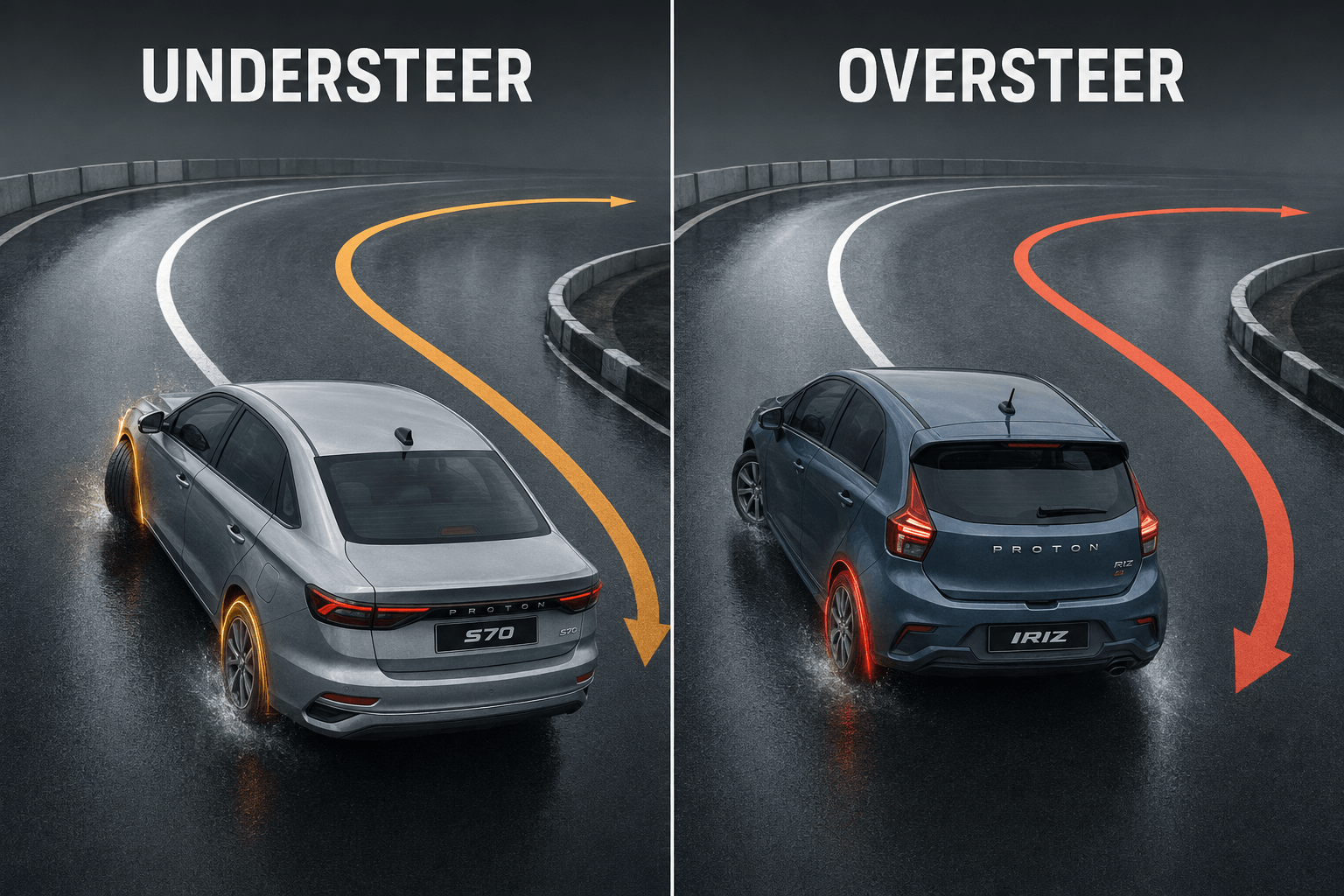
The difference in understeer vs oversteer comes down to which end of the car loses grip first in a corner. Understeer is when the front tyres slide and the car pushes wide of your intended line, while oversteer is when the rear tyres slide and the back of the car steps out.
What Is Understeer?
Understeer describes a car that turns less than the amount you ask for at the steering wheel. You point the wheel into a bend, but the nose keeps running toward the outside of the corner instead of following your chosen line. In plain terms, the front tyres have run out of grip before the rears.
This happens because the front tyres become saturated and start to slip first. Once the front cannot generate any more sideways force, the front of the vehicle follows a path of greater radius than the rear. To the driver, it feels like the steering has gone light and vague, and adding more lock does nothing.
For drivers in Malaysia, understeer most often shows up on rain-slicked highways, on the approach to a roundabout taken slightly too fast, or on a tightening expressway off-ramp. Because the car simply refuses to tuck into the bend, understeer can feel less alarming than oversteer, yet it still carries you off your line and toward the kerb or the next lane.
What Is Oversteer?
Oversteer is the opposite condition: the car turns more than you asked for because the rear tyres lose grip before the fronts. The back end slides outward, the nose points toward the inside of the corner, and the car begins to rotate. By the same definition, oversteer is most commonly understood as the rear tyres sliding sideways.
Where understeer feels like a stubborn push, oversteer feels sudden and twitchy. If it is not caught quickly, the rotation can spin the car. This is why oversteer demands a faster, more deliberate response from the driver, a point we return to in the correction sections below.
In everyday Malaysian driving, oversteer is far less common than understeer, since most road cars are deliberately set up to understeer for safety. Still, it can appear when a driver lifts off the throttle abruptly mid-corner or brakes hard while turning on a wet trunk road.
What Causes Understeer and Oversteer?
Both conditions come down to one idea: a tyre can only do so much at once, and when you ask for more grip than it has, it slides. Building on that idea, the specific triggers differ at each end of the car.
Understeer is usually caused by carrying too much speed into a corner or turning the wheel too sharply for the grip available. Accelerating too early in a front-wheel-drive car also loads the front tyres with both steering and driving demands at the same time, which pushes them past their limit. The result is the familiar wide, ploughing slide.
Oversteer, by contrast, tends to be triggered by what the driver does with weight. Too much power, a sharp lift off the accelerator, or hard braking mid-corner shifts load away from the rear tyres and reduces their grip. With less weight pressing the rear tyres into the road, they let go and the tail steps out.
Worn, underinflated, or mismatched tyres make either condition arrive sooner, because grip starts lower at every wheel. We cover the tyre side of the equation in detail further down, and you can also read more in this guide to uneven tyre wear.
How Drivetrain Layout and Weight Transfer Change the Balance
A car’s drivetrain shapes its natural tendency. Front-wheel-drive cars, which make up most of the models on Malaysian roads, are more prone to understeer because the front tyres handle steering and power delivery together. Rear-wheel-drive cars are more prone to oversteer because the rear tyres are the ones putting power down while the fronts steer.
Weight transfer is the other half of the story. When you brake, weight shifts forward onto the front tyres; when you accelerate, it shifts rearward; and when you corner, it shifts to the outside. Because the load on a tyre affects how much grip it can produce, these shifts constantly change the balance between front and rear during a single bend.
Putting those two factors together explains a lot of on-road behaviour. Lifting off the throttle mid-corner moves weight off the rear and can provoke oversteer, while getting back on the power too hard in a front-driven car loads the nose and brings on understeer. Smooth, progressive inputs keep weight transfer gentle and the car balanced.
How to Correct Understeer Safely
The instinct when a car runs wide is to add more steering lock, but that is exactly the wrong move. The front tyres are already overwhelmed, and turning the wheel further only asks more of tyres that have nothing left to give.
Instead, ease off the accelerator gently to let weight settle back onto the front tyres and restore their grip. At the same time, unwind a little steering lock rather than adding it. As the front tyres regain traction, the car will begin to follow your steering again, and you can smoothly feed the lock back in to complete the corner.
The guiding principle is patience and smoothness. Avoid stabbing the brakes, which can unsettle the car, and resist the urge to wrestle the wheel. Slowing your inputs is what gives the front tyres the moment they need to recover.
How to Correct Oversteer Safely
Oversteer asks for a quicker reaction because the car is rotating. The first step is to stay calm and look where you want to go, not at the hazard you are trying to avoid. Your hands tend to follow your eyes.
Next, steer into the slide. If the rear is sliding to the right, steer gently to the right to line the front wheels back up with the direction of travel. This is often called countersteering, and it must be smooth and measured, since too much correction can send the car snapping the other way. As the rear regains grip, gradually straighten the wheel.
Just as importantly, be gentle with the throttle and avoid sudden braking or sharply lifting off the accelerator, both of which can worsen the slide by shifting more weight off the rear. A small, steady throttle adjustment helps settle the car. These reactions do not come naturally, which is one reason modern electronic aids, covered below, are so valuable.
The Role of Tyres, Tread, and Pressure in Grip Balance
Every input you make reaches the road through four contact patches no bigger than your palm, so tyres set the ceiling on how much grip is available before understeer or oversteer begins. Healthy, well-matched tyres raise that ceiling at both ends of the car and keep the balance predictable.
Tread depth matters most in the wet, which is a daily reality during the Malaysian monsoon. Tread channels water away so the tyre can still touch the road, and the legal minimum tread depth in Malaysia is 1.6mm, though many safety experts advise replacing tyres well before that point. Below the limit, grip and braking both fall away, and aquaplaning becomes far more likely. You can confirm your tread with the simple coin test or by reading the wear indicators, and this guide on checking tread depth walks through it.
Pressure is just as decisive. In fact, correct inflation is essential for safe handling, even braking, and predictable cornering, while underinflation and overinflation both compromise grip and wear. Underinflated tyres flex too much and can overheat, while overinflated tyres reduce the contact patch. Set pressures to the figure on your driver’s door sticker and check them cold. Running mismatched grip front to rear, whether from uneven wear or different tyres, can tip a balanced car toward stubborn understeer or snappy oversteer.
How Electronic Stability Control Helps
Electronic stability control, often shortened to ESC, is a computerised system that detects and reduces loss of traction so the car keeps going where you steer. It continuously compares where you are pointing the wheel with where the car is actually heading.
When ESC senses a mismatch, it brakes individual wheels to pull the car back into line, and it may also trim engine power. The system can brake the outer front wheel to counter oversteer or the inner rear wheel to counter understeer, monitoring stability many times every second. In effect, it performs a faster version of the corrections described above.
The safety benefit is large. ESC reduces single-vehicle crashes significantly and prevents a majority of rollovers, which is why it has been mandatory on new passenger vehicles in many markets for over a decade. One caveat worth remembering, though, is that ESC can only work with the grip your tyres provide. On bald or badly underinflated tyres, even the best electronics have little to manage, so good tyres and good electronics work as a team.
Choosing Tyres That Keep You Balanced
Because every correction depends on grip, the tyres you fit are the single biggest factor in how your car behaves at the limit. This is where it helps to choose a proven brand. Yokohama is an award-winning Japanese tyre brand established in 1917 and was the first Japanese tyre maker to earn ISO 9001 certification, a recognised mark of consistent quality and engineering discipline.
That heritage runs through three product lines built for different needs. The performance-focused ADVAN range is engineered for handling precision and cornering stability, with options such as the track-bred ADVAN Neova AD09 for drivers who want sharp, confident turn-in. The GEOLANDAR line is built for SUVs and pickups across highway and off-road use, while the BluEarth line focuses on fuel saving and lower emissions for everyday efficiency. Whichever you need, Yokohama tyres are backed by the We Care Road Hazard Warranty for added peace of mind.
Buying with confidence is easy too. Yokohama Tyre Sales Malaysia is the sole official importer, and authorised dealers are available nationwide, so genuine products and proper fitting are always within reach. To find the right tyres for your car and keep your handling balanced in every corner, explore the full range from Yokohama.
Frequently Asked Questions
Is understeer or oversteer more dangerous?
Neither is inherently safe, but oversteer tends to develop faster and can spin the car if it is not caught quickly, while understeer usually carries you wide more gradually. Most road cars are deliberately tuned to understeer because it is more predictable for the average driver.
Why do most cars understeer rather than oversteer?
Carmakers build in a mild understeer bias as a safety margin, since lifting off the throttle, the natural reaction of most drivers, helps cure understeer but can make oversteer worse. Front-wheel-drive layouts, common in Malaysia, also lean naturally toward understeer.
Can tyres alone cause understeer or oversteer?
Yes. Worn, underinflated, or mismatched tyres lower the grip available at one end of the car and can bring on either condition sooner. Keeping all four tyres in good condition and correctly inflated is one of the simplest ways to keep handling balanced, and this guide to choosing the right car tyres is a useful starting point.
Does electronic stability control replace good driving?
No. ESC is a powerful safety net that intervenes when grip is slipping away, but it cannot create grip that is not there. Smooth inputs, sensible speeds for the conditions, and healthy tyres remain the foundation of safe cornering.
Sources
- National Highway Traffic Safety Administration – Electronic Stability Control Systems, FMVSS No. 126
- National Highway Traffic Safety Administration – Tire Safety Ratings and Awareness, TireWise
- U.S. Tire Manufacturers Association – Tire Care & Safety
- Paul Tan’s Automotive News – Minimum 1.6 mm tread depth across entire tyre surface a must for all commercial vehicles, JPJ
- Yokohama Tyre Malaysia – Home