
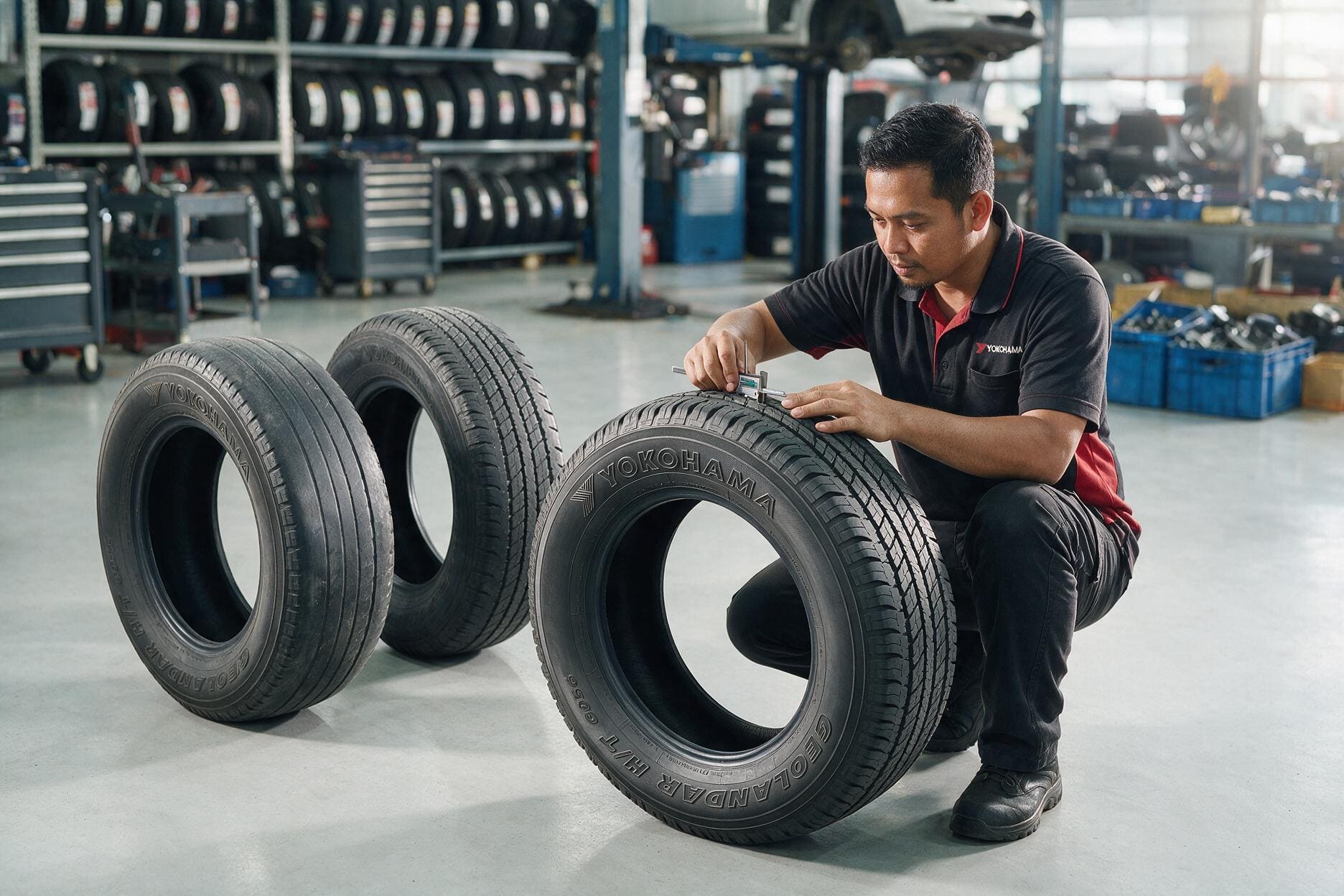
Tyre wear patterns are the uneven shapes and grooves that form across a tyre’s tread when pressure, alignment, suspension, or balance is out of specification. Each pattern points to a distinct mechanical cause, so learning to read them lets a driver in Malaysia catch a fault early, before it wears out a full set or compromises wet-weather grip.
Why Reading Tyre Wear Patterns Matters
A tyre’s tread is the only part of a car that touches the road, so how it wears down is a readout of everything happening above it. Even wear means pressure, alignment, and suspension are all working as intended. An uneven pattern is the tyre reporting a fault long before a warning light would, and catching it early separates a small adjustment from an early replacement.
In Malaysia, this habit carries extra weight. Monsoon downpours hide potholes and erode road edges, heat pushes tyre pressure around, and stop-start city traffic accelerates wear on whichever part of the tread already carries the most load. A five-minute check each month catches most of these problems before they become expensive.
Centre Wear: The Sign of Over-Inflation
Centre wear shows up as a strip of tread worn thinner down the middle, with both shoulders still relatively fresh. An over-inflated tyre bulges outward in the middle, so the centre carries most of the vehicle’s weight and grinds down faster than the edges. Drivers sometimes over-inflate deliberately, believing it saves fuel, but the trade-off is a shorter tyre life and a smaller contact patch in the wet.
The fix is to bleed the tyres to the figure printed on the door placard, not the maximum figure moulded onto the sidewall, which is only the pressure ceiling. This is worth checking monthly, and Yokohama’s guide on optimal air pressure covers how temperature and load affect the correct reading.
Shoulder Wear: The Sign of Under-Inflation
Shoulder wear, sometimes called both-edge wear, is the mirror image of centre wear: both outer edges wear down while the centre stays deep, because an under-inflated tyre flattens out and rolls onto its shoulders under load. This also raises rolling resistance and heat build-up, a common preventable cause of early tyre failure.
The fix again is matching the door placard figure, since under-inflation is gradual and easy to miss. Malaysia’s daytime heat pushes pressure up during a drive and lets it drop overnight, so cold-morning checks give the truest reading, using the front and rear figures, which often differ.
One-Sided or Edge Wear: The Sign of Misalignment
When only one edge of a tyre, inner or outer, wears faster than the rest of the tread, the cause is almost always wheel misalignment rather than pressure. Two angles are usually responsible: camber, the inward or outward tilt of the wheel viewed from the front, wears down whichever edge tilts closer to the road, while toe, the angle at which the tyre points slightly inward or outward relative to the direction of travel, drags one edge sideways with every rotation.
Because this comes from a geometry fault, no amount of careful pumping will fix it. It needs a proper wheel alignment on a calibrated machine, which resets camber, toe, and caster to specification. Yokohama’s guide on uneven tyre wear breaks down how to spot this pattern early.
Feathering: The Sign of Toe Misalignment or Worn Suspension
Feathering produces a tread that feels smooth one way and rough or jagged the other, because each tread block develops a sharp edge on one side and a rounded edge on the other. It is almost always traced to incorrect toe alignment, or to worn suspension bushings and ball joints that let the wheel shift slightly under load.
Since feathering is a variant of the same misalignment problem, the fix is the same wheel alignment, paired with a suspension check if the bushings or tie rod ends show play. Left uncorrected, feathering worsens quickly because the jagged edges generate more noise and heat, which accelerates the wear that caused them.
Cupping or Scalloping: The Sign of Worn Suspension or an Imbalanced Ride
Cupping, also called scalloping, appears as dips or scooped-out patches spaced evenly around the tread, giving it a wavy rather than flat surface. It is caused by the tyre bouncing slightly as it rotates instead of holding constant contact with the road, pointing to worn shock absorbers, struts, or other suspension parts that can no longer control its motion. A wheel out of balance can produce a similar effect and worsen existing cupping.
Because the tyre is usually not the origin of the fault, the fix starts with a suspension check rather than the tyre shop. Worn shocks or struts need replacing, and the wheels should be rebalanced afterward. Cupped tyres are also noticeably noisier on the highway, often the first symptom a driver notices.
Flat Spots: The Sign of Hard Braking, Imbalance, or Long Parking
A flat spot is a localised area of tread worn flatter than the rest of the circumference, usually from one of three sources. Hard, sudden braking that locks a wheel drags one section against the road under full friction. A wheel out of balance can create a mild vibration that wears one spot preferentially over thousands of rotations. A car parked in the same spot for weeks can develop a temporary flat that sometimes works itself out after a short drive but can be permanent in older, drier rubber.
The fix depends on the cause. Braking-induced flat spots are usually cosmetic if caught early, but a wheel balance should be checked if the flat spot recurs. For a car sitting unused for a long period, moving it periodically or slightly over-inflating for storage, then correcting it before driving, reduces the risk of a lasting flat.
How to Inspect Your Own Tyres
A proper inspection takes only a few minutes with a flat surface and good light. Run a bare hand across the tread in both directions, since feathering and cupping are often easier to feel than see. Compare the depth at the centre against both shoulders across the full width, using a coin as a simple gauge and checking several points around the circumference, since wear is rarely even all the way round. Yokohama’s guide on spotting worn-out tyres covers other warning signs worth checking at the same time, such as sidewall cracking.
Malaysia’s legal minimum is a tread depth of 1.6mm across the tyre’s surface, a standard the Road Transport Department has tightened for commercial vehicles, requiring the full contact area, not just most of it, to pass inspection. Yokohama’s guide on checking tread depth explains how to measure this at home, and it is worth checking all four tyres individually rather than assuming they wear at the same rate.
The Fixes: Pressure, Alignment, Rotation, and Suspension
Most tyre wear problems trace back to one of four fixes, run through periodically to catch issues before they turn into a visible pattern. Correcting pressure to the door placard figure addresses centre and shoulder wear and should be checked monthly when cold. A wheel alignment resets camber and toe whenever a tyre shows one-sided wear or feathering, and is worth scheduling right after hitting a significant pothole or kerb, not just on a fixed calendar. Rotating tyres front to back every 10,000 kilometres, or as the manufacturer recommends, evens out the load so none absorbs a disproportionate share of wear. Finally, a suspension and balancing check catches cupping and flat spots at their source, since no pressure or alignment fix corrects a worn shock absorber or an out-of-balance wheel.
Why Acting Early Saves the Set
Every wear pattern gets more expensive the longer it runs unchecked. A tyre with early shoulder wear can usually be corrected with a pressure adjustment, but one left under-inflated for months may need replacing years early, often taking its axle partner with it; Yokohama’s guide on when to change car tyres helps judge that timing. Wear pattern also affects wet grip directly, since an unevenly worn tyre channels water less efficiently from the contact patch, raising the risk of aquaplaning in Malaysia’s heavier downpours.
Uneven wear is also a warning sign about the rest of the car. A tyre that keeps cupping after a balance and rotation is telling its owner that a suspension component has failed, and driving on it accelerates wear on the replacement too. Reading the pattern early, then fixing the actual cause, keeps a full set running to its intended mileage.
The Malaysia Angle: Potholes, Heat, and Rotation Habits
Malaysian roads present a specific combination of stresses that make wear-pattern awareness especially useful. Monsoon rain regularly exposes or worsens potholes, and hitting one at speed, or clipping a kerb while navigating flooded roads, can knock a wheel’s alignment out of specification in a single impact, after which one-sided or feathered wear often appears within weeks. High daytime heat also raises tyre pressure measurably, so a midday check can read higher than the same tyre in the morning, making cold checks the more reliable habit.
Rotation habits also tend to slip in traffic-heavy cities, where short, frequent trips make a scheduled rotation easy to postpone. Building it into an existing routine, such as a service interval, spreads wear evenly across all four tyres. Drivers who tow, carry heavy loads, or drive mostly on the highway should rotate somewhat more often.
Even Wear Begins With the Right Tyre and the Right Habits
Reading a wear pattern correctly only pays off if the tyre underneath was built to wear evenly in the first place, so the starting point matters as much as the maintenance routine. Yokohama has manufactured tyres since 1917 and has built a reputation as an award-winning Japanese tyre brand, and it was the first Japanese tyre maker to achieve ISO 9001 certification for its manufacturing quality. That discipline shows up in its three core ranges in Malaysia: the performance-focused ADVAN line, the SUV and 4×4-tuned GEOLANDAR line, and the fuel-efficient, long-mileage BluEarth line, each built to resist the wear patterns most common to its use case.
Pairing a well-built tyre with correct pressure, alignment, and rotation is what actually prevents premature wear, and Yokohama backs that pairing with its We Care Road Hazard Warranty for extra peace of mind. Malaysian drivers can have their tyres inspected, rotated, and balanced at Yokohama’s authorised dealers nationwide, all supplied through Yokohama Tyre Sales Malaysia, the brand’s sole official importer, which keeps warranty and quality standards consistent wherever a driver buys. For the full ADVAN, GEOLANDAR, and BluEarth ranges and the nearest dealer, visit Yokohama Tyre Malaysia.
Frequently Asked Questions
What causes uneven tyre wear patterns?
Uneven tyre wear comes from one of four sources: incorrect pressure, wheel misalignment, worn suspension, or a wheel out of balance. Each produces a distinct pattern, from centre wear for over-inflation to cupping for worn shocks, which is what makes the pattern useful for diagnosis rather than just a symptom to fix cosmetically.
Can uneven tyre wear be corrected without buying new tyres?
Yes, in many cases. If caught early and the tread still has legal depth remaining, correcting the pressure, alignment, or balance stops the pattern from worsening and lets the tyre run out its remaining mileage. Once wear has reduced tread depth close to Malaysia’s 1.6mm legal minimum in the affected area, replacement becomes the safer option.
How often should tyres be checked for wear patterns in Malaysia?
A monthly visual and hand check, timed to a cold tyre pressure check, is enough for most drivers. Tyres should also be inspected immediately after hitting a significant pothole or kerb, since Malaysia’s monsoon season makes this kind of impact more common and alignment faults tend to show up within a few weeks.
Is it safe to keep driving on a tyre with cupping or feathering?
Not for long. Both patterns indicate an underlying fault, either worn suspension or misalignment, that will keep worsening the tyre’s condition and its wet-weather handling until corrected. A vehicle showing either pattern should have its suspension and alignment checked promptly rather than waiting for the next scheduled service.
Sources
- NHTSA – Tire Safety Ratings and Awareness: TireWise
- U.S. Tire Manufacturers Association – Tire Care and Safety
- RAC Drive – What Can Cause Excessive or Uneven Tyre Wear?
- Consumer Reports – Tire Safety Checklist: What to Do Before Your Next Road Trip
- Paul Tan’s Automotive News – Minimum 1.6mm Tread Depth Across Entire Tyre Surface a Must for All Commercial Vehicles, JPJ
- Yokohama Tyre Malaysia – Yokohama Tyre Sales Malaysia