
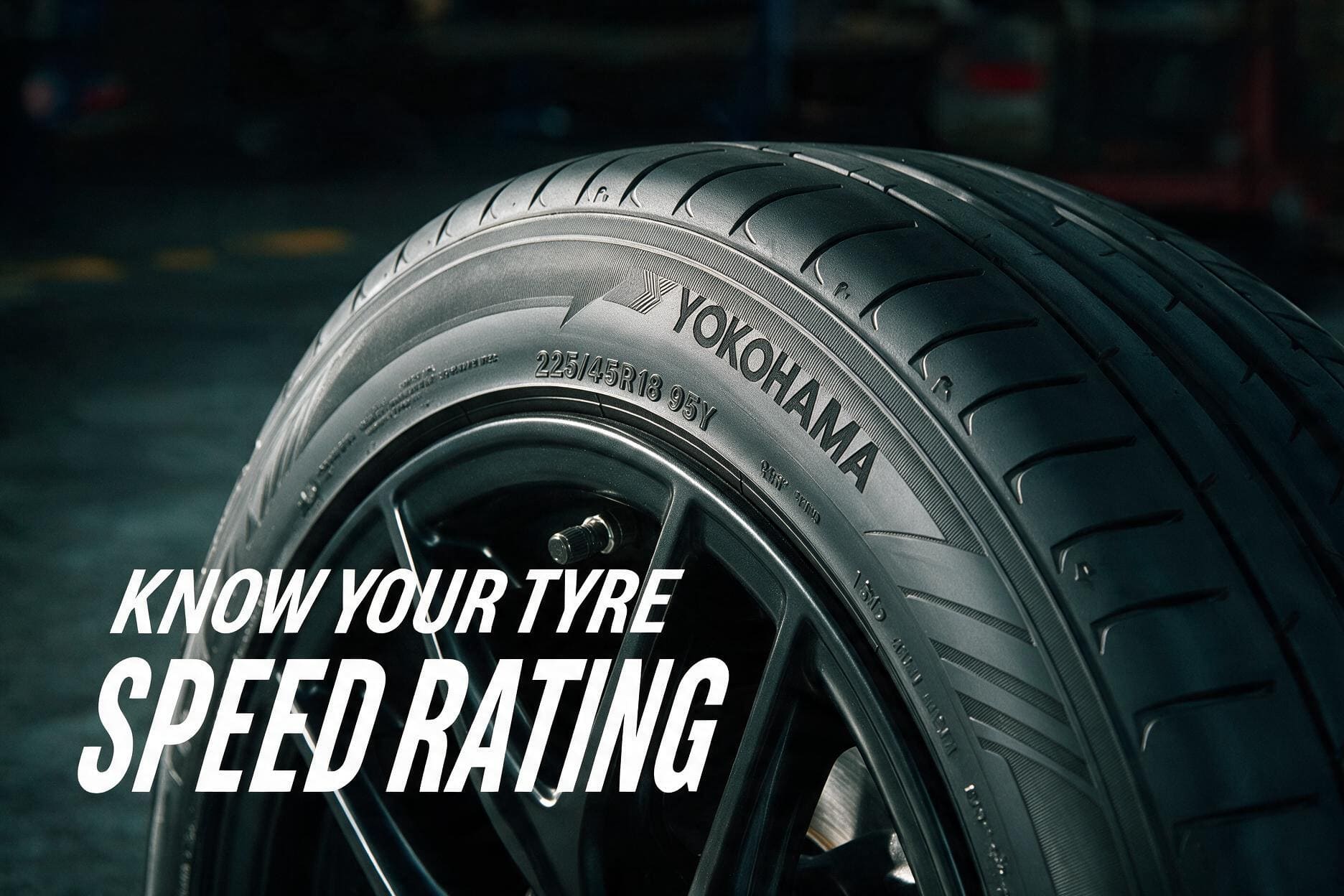
A tyre speed rating is the letter on your tyre’s sidewall that states the maximum speed the tyre is built to sustain safely when properly inflated and loaded. It is part of the size code stamped on every tyre, and it tells you, at a glance, the speed ceiling the tyre was engineered and tested to handle.
This single letter carries more weight than most drivers realise, because it reflects how the tyre manages heat, grip, and structural stress at speed. This guide explains how to read your tyre speed rating, what the full chart means, and which rating actually makes sense for driving in Malaysia.
What Is a Tyre Speed Rating?
A tyre speed rating is a standardised letter that certifies the top sustained speed a tyre can safely maintain. It is a letter code marking the maximum speed a tyre is certified for, and it always appears at the very end of the tyre size code, right after the load index number, for example 91V or 99W.
The rating is earned during design and certification, not estimated. Speed ratings are set by practical high-speed tests carried out when a tyre is designed and certified, with the tyre pressed against a test drum and run at progressively higher speeds in controlled conditions until it reaches the speed the rating represents. A tyre passes only if it holds together and performs without failure at that speed.
Heat is the reason this test matters. The faster a tyre spins, the more heat builds inside it, and a higher-rated tyre is constructed with compounds and reinforcement that shed that heat and resist deformation. In short, the speed rating is really a measure of how much sustained stress the tyre’s structure can take.
How to Read the Speed Rating on Your Tyre
Your speed rating sits inside the size code on the sidewall, so finding it just means decoding that string. A typical code such as 205/55 R16 91V breaks down into width, profile, construction, rim size, load index, and finally the speed rating letter.
In that example, the V at the end is the speed rating. The number before it, 91, is the load index, which is a separate value telling you how much weight the tyre can carry, so it is important not to confuse the two.
Reading the rest of the sidewall fills in the full picture of your tyre. Our guide on how to read tyre markings and codes walks through every symbol, from the manufacturing date to the load index, so you can interpret the whole sidewall and not just the speed letter.
One point catches many buyers out. The speed rating describes the tyre’s capability under ideal conditions, with correct pressure and load, so a worn, underinflated, or overloaded tyre will not deliver its rated speed safely.
The Full Tyre Speed Rating Chart
The speed rating system runs as a sequence of letters, where each letter maps to a specific maximum speed. The letters mostly climb in alphabetical order, with one quirk worth remembering at the top.
The common passenger-car ratings and their limits are as follows. T is rated to 190 km/h, H to 210 km/h, V to 240 km/h, W to 270 km/h, and Y to 300 km/h.
The H rating is the quirk in the sequence. Although the letters are otherwise alphabetical, H sits between U (200 km/h) and V (240 km/h) for historical reasons, so a higher letter does not always mean a higher speed across the whole range.
You may also see ZR in the code on very high-performance tyres. This older marking indicates a tyre rated above 240 km/h, and it is usually paired with a W or Y letter that gives the exact ceiling.
A related grading also speaks to speed. In the Uniform Tire Quality Grading system, the temperature grade reflects a tyre’s resistance to heat at speed, and grade A is able to withstand speeds over 115 mph.
Which Speed Rating Do You Need in Malaysia?
For everyday driving in Malaysia, the practical answer is to match or exceed the rating your carmaker originally specified. That figure is printed on the tyre placard on the driver’s door and in your owner’s manual, and it was chosen to suit your car’s performance and weight.
The legal context here is generous relative to most tyres. The maximum speed limit on Malaysian expressways is 110 km/h, which sits far below even a modest T-rated tyre, so for ordinary cars almost any current passenger tyre clears the legal speed with a wide safety margin.
That margin is the point, not the headroom for speeding. A higher rating generally brings stiffer construction and firmer grip, which improves stability, cornering response, and braking feel even at normal speeds, so the rating benefits safety long before you approach its limit.
Downgrading is the real risk to avoid. You may fit a tyre with a higher speed rating than the one specified, but never a lower one, and the load index must also be respected. Fitting a tyre rated below your carmaker’s specification can void aspects of your insurance and leaves less structural margin for sustained highway heat, so when replacing tyres you should never drop below the original rating.
Speed Rating, Load Index, and Tyre Choice Together
A speed rating means little in isolation, because it works alongside the load index to define a tyre’s true capability. The two values together must suit your vehicle’s weight and the way you drive.
For heavier vehicles such as SUVs and people-movers, the load index matters as much as the speed letter. A tyre with a high speed rating but an inadequate load index is still the wrong tyre, since it cannot safely carry a fully loaded family vehicle on a long trip.
This is why choosing tyres is a balance rather than chasing one number. Reading both values correctly ensures the tyre matches how you actually use your car on Malaysian roads.
Choose a Tyre Engineered for the Speed You Drive
Understanding speed ratings is only useful when paired with a tyre that genuinely delivers on its rated number, which comes down to the engineering behind the brand. A quality tyre maker designs the compound and casing so the rating is matched by real-world grip, heat resistance, and durability.
This is where Yokohama stands apart. Yokohama is an award-winning Japanese tyre brand established in 1917 and the first Japanese tyre maker to earn ISO 9001 certification, a heritage of quality assurance that shows up in tyres built to perform exactly to their rating. The range suits every driver, from the high-performance ADVAN line for spirited and sports driving, to the rugged GEOLANDAR SUV and off-road range, to the efficient and comfortable BluEarth line for daily commuting.
Buying Yokohama also means lasting support. Every set is backed by the We Care Road Hazard Warranty and a network of authorised dealers nationwide, with Yokohama Tyre Sales Malaysia as the sole official importer. To find a correctly rated tyre matched to your car, explore the full range at Yokohama.
Frequently Asked Questions
What does the speed rating letter on a tyre mean?
The letter states the maximum speed the tyre can safely sustain when correctly inflated and loaded, based on a standardised drum test. For example, a V rating means the tyre is built to handle sustained speeds up to 240 km/h.
Can I use a tyre with a higher speed rating than recommended?
Yes, fitting a higher-rated tyre than your carmaker specifies is generally safe and can improve handling and stability. Just make sure the load index still suits your vehicle, since a higher speed letter does not guarantee a higher load capacity.
Is it illegal to use a lower speed rating tyre in Malaysia?
While the legal speed limit of 110 km/h is below most tyre ratings, fitting tyres rated below your carmaker’s specification reduces your safety margin and can affect insurance claims. It is strongly advised to match or exceed the original rating rather than downgrade.
Where do I find my tyre’s speed rating?
The speed rating is the final letter in the size code on the tyre sidewall, right after the load index number. You will also find the recommended rating on the tyre placard on the driver’s door edge and in your owner’s manual.
Does a higher speed rating wear out faster?
Higher-rated tyres often use softer, grippier compounds that can wear slightly faster than harder-wearing lower-rated tyres. The trade-off is better grip and stability, so the right choice depends on whether you value tread life or performance more.
Sources
- The AA – Tyre Speed Rating: Chart and Rating Letters
- TyreSafe – Tyre Speed Ratings Explained
- RAC – What is a Tyre Speed Rating?
- National Highway Traffic Safety Administration – Consumer Guide to Uniform Tire Quality Grading
- U.S. Tire Manufacturers Association – Tire Care & Safety
- Yokohama Tyre Malaysia – Home