
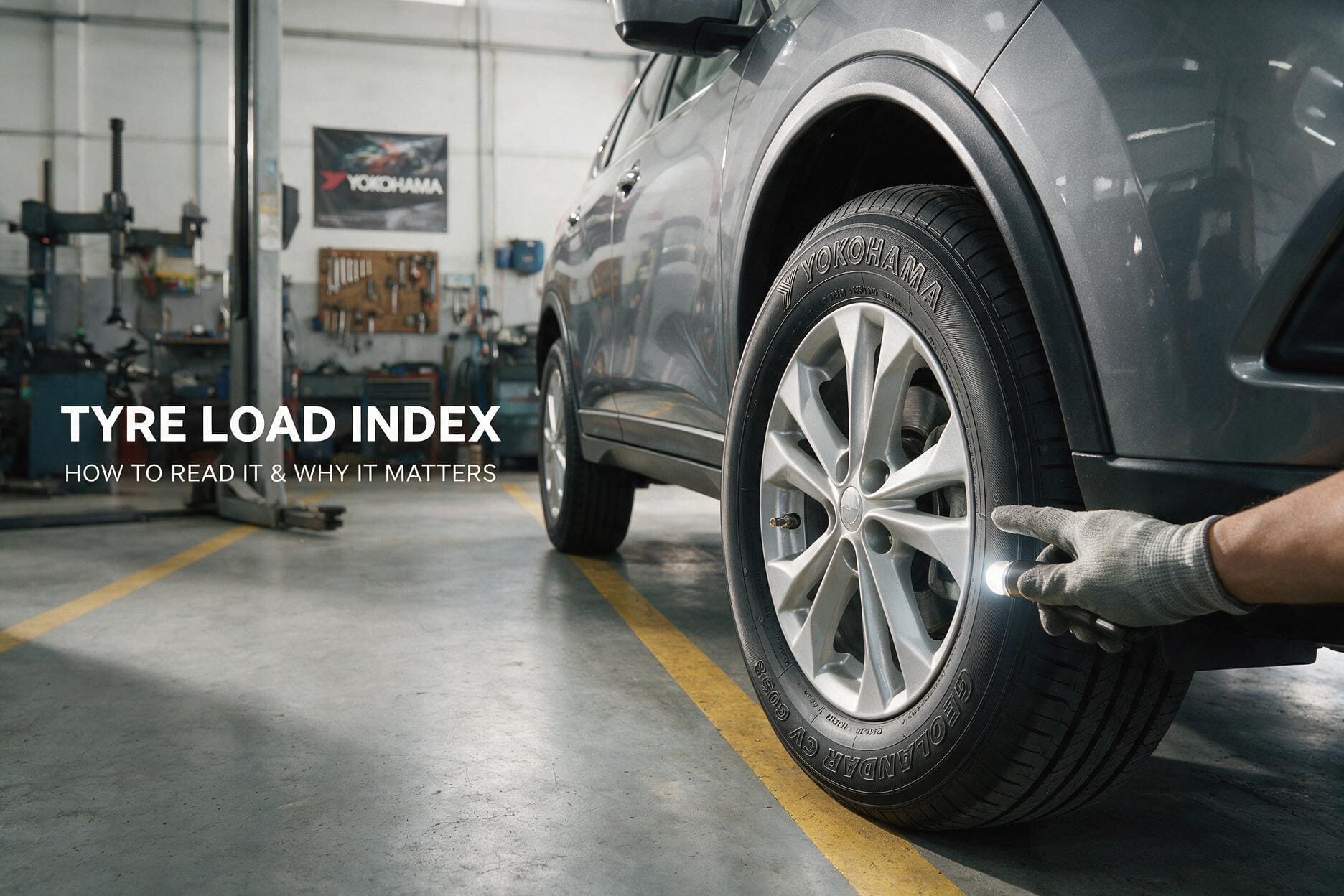
The tyre load index is the small number on your sidewall that tells you the maximum weight one tyre can safely carry when it is properly inflated. It sits just before the speed-rating letter in your tyre size code, and reading it correctly is one of the simplest ways to keep a loaded car safe on Malaysian roads.
Most drivers can recite their tyre width and rim size but draw a blank at the two digits that matter most when the boot is full. This guide breaks down what the number means, how to convert it into kilograms, and how to choose a rating that suits the way you actually drive in Malaysia.
What is the tyre load index?
The tyre load index is a numerical code that represents the maximum weight a single tyre is designed to carry when it is inflated to the correct pressure. The larger the number, the more the tyre can support, so this is one of the figures that decides how much weight your car can carry without putting the tyres under stress that risks failure, as the maximum load capacity printed in coded form on every sidewall makes clear.
The index is paired with a separate speed rating, and the two work together. The load index answers the question of how heavy, while the speed letter answers how fast. Both are set during laboratory testing, which is why neither should be treated as a rough guide. They are engineering limits, not suggestions.
It helps to think of the index as a shorthand. Rather than mould a long weight figure onto the rubber, manufacturers print a short code that points to a standard load value. Once you know how to translate the code, the sidewall starts to read like a spec sheet.
Where to find the tyre load index on the sidewall
You will find the tyre load index near the end of the tyre size string, as the second-to-last element before the speed letter. Take a common size such as 205/55R16 91V. The 205 is the width in millimetres, the 55 is the aspect ratio, R16 is the rim diameter, and then comes the part that matters here: the 91 is the load index and the final V is the speed rating, with the load index always sitting between the rim diameter reading and the speed letter at the very end.
Reading the full string in order makes this easy to remember. Width, profile, construction, diameter, then load index, then speed. The load index is the two or three digit number tucked in just before that final letter. If you want a complete walkthrough of every symbol on the rubber, the date stamp and construction type included, you can explore our breakdown of every tyre sidewall marking.
Crucially, the load index is per tyre, not per vehicle. A figure of 91 describes what one tyre can hold, so a four-tyre set multiplies that capacity across the axles. That distinction matters the moment you start adding passengers and cargo.
How to read common load index values in kilograms
The tyre load index is not a weight in itself; it is a code that maps to a weight on a standard scale. To make sense of the digits, you convert them into kilograms. A load index of 91 corresponds to roughly 615 kg per tyre, which is the exact figure tyre engineers assign to that code, as the standard conversion that pairs the number 91 with a maximum of 615 kg confirms.
Moving up the scale, a load index of 95 supports about 690 kg per tyre, and a load index of 100 supports about 800 kg per tyre. The pattern is consistent: every step up the index adds carrying capacity, so a higher number always means a stronger tyre in load terms. Passenger-car indexes typically run from roughly 75 to 105, which covers everything from a light city hatchback to a fully loaded seven-seater.
To picture the whole car, multiply the per-tyre figure by four. Four tyres at index 91 give a combined ceiling near 2,460 kg, which has to cover the weight of the car itself plus everyone and everything inside it. Seen that way, the margin between an empty car and a packed one is smaller than many drivers assume.
How to work out your vehicle’s load index needs
Your starting point is the carmaker’s own recommendation, not a number you pick yourself. The figure printed on the vehicle’s tyre placard, usually on the driver’s door edge or door pillar, and repeated in the owner’s handbook, is the minimum load index your car requires, and that placard and handbook combination is the official source for the minimum rating your vehicle was built around.
From there, the rule is straightforward: you can fit a tyre with a higher load index than the recommended figure, but you must never fit one with a lower index. A tyre rated below the manufacturer’s minimum cannot safely support the weight the vehicle was designed to carry, and fitting a higher rating than the original equipment is the only acceptable change, as the guidance that you may go higher but never lower spells out.
A higher index is sometimes a sensible upgrade, especially if you regularly carry heavy loads or have added accessories such as roof racks or towing gear. If a change of tyre size is also on the table, the relationship between size, load, and pressure is worth understanding first, which our tyre upsizing guide sets out in detail. When in doubt, choosing a tyre that meets or exceeds the placard figure keeps you on the right side of the limit, and our advice on choosing the right car tyres walks through the wider decision.
Why the tyre load index matters for safety
Getting the load index right is a safety decision, not a technicality. A tyre carrying more than its rated weight runs hotter, flexes more than it was built to, and is far more likely to suffer a dangerous failure, because exceeding the index puts extra stress on the tyre that can lead to rapid wear and even a blowout. Heat is the enemy here, and an overloaded tyre generates it faster than it can shed it.
This becomes most dangerous in exactly the situations Malaysian families know well. Picture a car packed for a balik kampung trip: five passengers, a boot full of luggage, gifts on the parcel shelf, and hours of motorway driving in the afternoon heat. That is precisely when staying within the vehicle’s load limit matters most, and keeping the load on each tyre below its rated ceiling is the single habit that protects against overload-related failure on long trips. Underinflation makes the problem worse, since a soft tyre carries less than its rated weight, so correct pressure and correct load rating go hand in hand. If your tyres are also worn or ageing, the margin for error shrinks further, and our guide on when to change your car tyres explains the warning signs to watch.
The load index and speed rating together
The load index and the speed rating describe two halves of the same promise, and they are linked. A tyre’s rated load applies at its rated speed, so the figures are tested as a pair rather than in isolation. The speed letter that follows the load index, such as the V in 205/55R16 91V, marks the maximum sustained speed the tyre can safely handle while carrying its rated load, and the principle that load capacity and speed capability are certified together is why both markings appear side by side.
In practice this means you should match both numbers to your car, not just one. The same advice that applies to the load index applies to the speed rating: you can fit a higher rating than the original equipment, but fitting a lower one undermines the safety margin the carmaker designed in. Replacing tyres with a matching or higher specification on both counts keeps the handling and load behaviour the vehicle was engineered for.
The Malaysia angle: heat, loads, and full cars
Malaysian driving conditions put the load index to the test more often than many drivers realise. Family cars and seven-seater SUVs here are frequently loaded close to capacity, whether for the school run with the whole family aboard or a long interstate drive, and the tropical heat means tyres already operate at higher temperatures before any extra load is added.
Festive travel sharpens the point. During balik kampung season the roads fill with cars carrying maximum passengers and cargo over long distances, and overloading is repeatedly flagged as a leading contributor to tyre failures on Malaysian highways, with pre-journey vehicle checks that include tyres and loading strongly advised before any long-distance trip. Choosing tyres with an adequate load index, keeping them correctly inflated, and resisting the urge to overpack are the practical defences. The hotter and heavier the conditions, the less room there is to gamble on a borderline rating.
Matching the right load rating to your vehicle with Yokohama
Reading the load index correctly is only useful if the tyre you fit lives up to its number, and that is where the maker behind the rubber matters. Choosing a load rating that suits your car is a decision about trust as much as arithmetic, and it is worth buying from a brand with a long record of engineering tyres to do exactly what their markings promise.
Yokohama is an award-winning Japanese tyre brand founded in 1917 and was the first Japanese tyre maker to earn ISO 9001 quality certification, a heritage that runs through its three core lines: the performance-focused ADVAN, the SUV and light-truck GEOLANDAR, and the fuel-efficient BluEarth range. Every Yokohama tyre sold here is backed by the We Care Road Hazard Warranty and supported by authorised dealers nationwide, with Yokohama Tyre Sales Malaysia as the sole official importer, so the load index and speed rating you read on the sidewall are exactly what you get.
When you are matching a load rating to a fully loaded family car or a hard-working SUV, that combination of Japanese engineering, nationwide support, and genuine warranty cover is what turns a number on the sidewall into real peace of mind. Find the right tyre for the weight you carry at Yokohama.
Frequently asked questions
What is a good load index?
A good load index is one that meets or exceeds the figure on your vehicle’s door placard. For most passenger cars in Malaysia that falls somewhere in the roughly 75 to 105 range. There is no single best number; the right one is whatever matches or safely exceeds what your specific car requires.
Can I use a higher load index?
Yes. You can fit a tyre with a higher load index than the manufacturer’s recommendation, and it can be a sensible choice if you often carry heavy loads. What you must never do is fit a lower index than the placard figure, because the tyre would not be rated to support your vehicle’s weight.
What does load index 91 mean?
A load index of 91 means each tyre can carry a maximum of about 615 kg when properly inflated. Across a set of four tyres that gives a combined capacity of roughly 2,460 kg, which has to cover the car plus all passengers and cargo.
Where is the load index on my tyre?
It is the two or three digit number near the end of the size code on the sidewall, sitting just before the speed-rating letter. In 205/55R16 91V, the 91 is the load index.
Sources
- The AA – Tyre speed rating and load index explained
- RAC – What is a tyre speed rating and load index?
- TyreSafe – Car tyre load and speed markings
- NHTSA – Tire safety ratings and awareness (TireWise)
- Paul Tan’s Automotive News – Balik kampung vehicle checklist and guide