
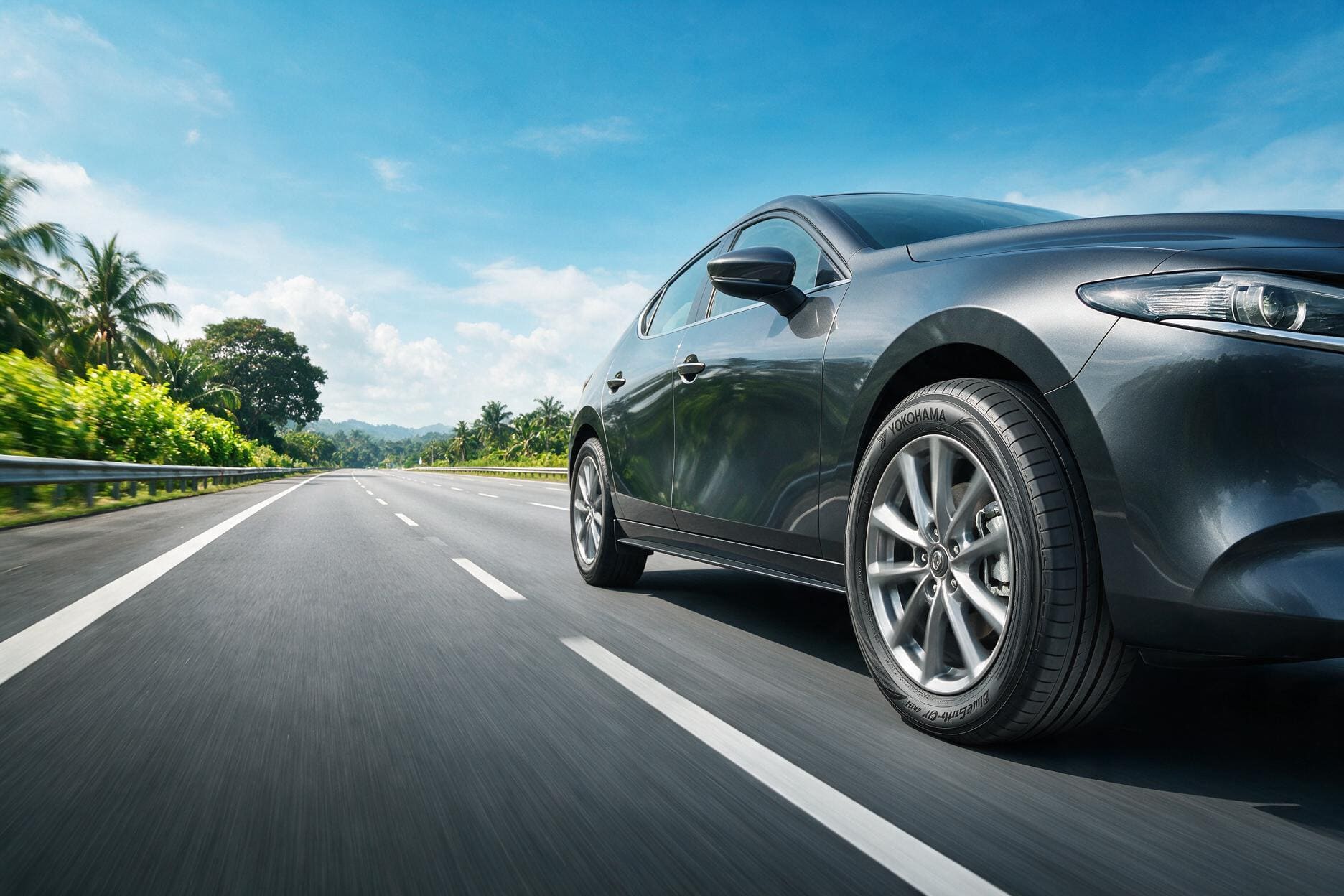
Fuel economy tyres are tyres engineered with low rolling resistance so your engine burns less fuel to keep the car moving. They trim running costs and emissions without asking you to change how you drive.
Rising pump prices and long daily commutes make fuel-saving choices matter more than ever for Malaysian drivers. The tyres under your car are one of the most overlooked of those choices, yet they influence how far every litre takes you. This guide explains what fuel economy tyres are, how much they can save, how the labels work, and how to squeeze the most out of them in Malaysia.
What Are Fuel Economy Tyres?
Fuel economy tyres, also called eco tyres or low-rolling-resistance tyres, are designed to lose less energy as they roll. The design goal is efficiency: use tread compounds, tread patterns, and construction that reduce wasted energy while still gripping the road safely.
The saving comes from the tyre itself, not the engine. Manufacturers reformulate the rubber compound, refine the tread design, and adjust the internal structure so the tyre flexes less and recovers energy more effectively. The result is a tyre that asks the engine for less fuel to travel the same distance.
Because they are a normal fit for everyday cars, eco tyres suit the typical Malaysian driver commuting on highways and city roads. They are not a niche product; they are a mainstream option that happens to prioritise efficiency alongside grip and comfort.
How Rolling Resistance Works
Rolling resistance is the energy a tyre loses as it flexes under the weight of the car, and that lost energy has to be replaced by burning fuel. Every time a section of tread meets the road, the tyre deforms and springs back, and a little energy escapes as heat during that cycle.
The engine makes up for that loss. The more energy a tyre wastes to heat, the harder the engine works and the more fuel it consumes to hold your speed. Lowering rolling resistance therefore cuts the fuel bill directly, because a tyre with characteristics that reduce energy loss improves fuel economy for the same journey.
Tyre engineers reduce this loss mainly through the rubber compound and the tyre structure. Silica-based compounds flex with less internal friction, and stiffer, more efficient construction limits how much the tyre distorts. Less distortion means less wasted heat, and less wasted heat means better mileage.
How Much Fuel Can You Save?
Tyres account for a meaningful share of the fuel a car uses, so choosing efficient ones and keeping them in good shape pays off over time. Estimates put the effect of rolling resistance at a few percent of overall fuel consumption, which adds up across thousands of kilometres a year.
The gains are real but modest, so honest expectations help. A widely cited engineering estimate is that a 10 percent reduction in tyre rolling resistance yields roughly a 1 to 2 percent improvement in vehicle fuel economy. Switching to low-rolling-resistance replacement tyres, and keeping them correctly inflated, can therefore deliver a noticeable saving without any change to your driving.
Two factors decide whether you see that saving. The first is the tyre you choose, and the second is how you maintain it. A good eco tyre run at the wrong pressure gives back much of its advantage, which is why tyre choice and maintenance work as a pair rather than in isolation.
The EU Tyre Label and Fuel Efficiency
The European tyre label grades fuel efficiency on a clear scale, so you can compare tyres before you buy. The label rates each tyre for rolling resistance, wet grip, and external noise, giving buyers a standard reference rather than marketing claims.
Fuel efficiency runs from class A, the most efficient, down to the lowest class on the scale. The label first entered force in the European Union in 2012 and has helped reduce energy consumption across the bloc, and a properly inflated low-rolling-resistance tyre can have as much as a ten percent savings impact on running costs. An A-rated tyre uses less fuel than a poorly rated one of the same size, which is exactly the comparison the grading is meant to make easy.
The wet grip grade sits on the same label for a reason. It reminds buyers that efficiency is only one of three qualities, and that a fuel-efficient tyre should still stop well on a wet road, which matters a great deal in a country with frequent heavy rain.
The Trade-offs to Watch
Fuel economy is one property among several, so the smart choice balances efficiency with grip and tread life. Chasing the lowest possible rolling resistance can, in poorly designed tyres, come at the cost of wet braking or tread longevity, and neither is worth sacrificing.
Safety is the property you never trade away. Wet grip determines how quickly you can stop in the rain, so a tyre that saves a little fuel but stops poorly on a wet road is a bad bargain. The best eco tyres are engineered to deliver low rolling resistance and dependable wet performance together, which is why the label reports both.
Tread life is the other consideration. A tyre that wears out quickly costs more to replace and, once worn, grips less safely, since a minimum tread depth of 1.6 mm across the contact surface is the legal floor for roadworthiness. Reading a tyre’s ratings and choosing a balanced design protects your fuel savings, your safety, and your wallet at once. Our guide on how to choose the right car tyres walks through weighing these qualities against one another.
Maximising Your Savings Beyond Tyre Choice
The tyre is only half the equation, because how you look after it decides how much fuel you actually save. Good maintenance can match or beat the benefit of the tyre itself, and most of it costs nothing.
Correct tyre pressure is the single biggest lever. Keeping tyres inflated to the pressure the vehicle manufacturer recommends can improve fuel economy by around 3 percent in the best cases, and every drop below the correct pressure quietly raises consumption. Check pressure at least once a month when the tyres are cold, using the figure on the driver’s door label rather than the number on the sidewall. Our explainer on optimal air pressure sets out how to do this properly.
Three more habits protect both economy and safety. Wheel alignment stops tyres from scrubbing against the road and wearing unevenly, balancing keeps the wheels spinning smoothly, and regular rotation evens out wear so the whole set lasts longer and holds its efficiency. Underinflation is common and costly, since only a minority of drivers keep their tyres correctly inflated, so a monthly check is the easiest saving available.
Why Fuel Economy Tyres Make Sense in Malaysia
Malaysian conditions make efficient tyres especially worthwhile. Fuel costs weigh on household budgets, commutes between suburbs and city centres are long, and the constant heat places extra demand on tyres, so any consistent saving is welcome.
Heat is the local factor drivers underestimate. High road and air temperatures raise the risk of underinflation being missed and accelerate wear, both of which erode fuel economy, so pressure discipline matters more here than in cooler climates. A tyre built to run cool and resist wear holds its efficiency better through Malaysian conditions.
Distance is the other factor. Long daily kilometres mean small per-kilometre savings compound into a real annual figure, so a few percent better economy on a highway commute is money back every month. For drivers covering serious mileage, the right eco tyre plus disciplined pressure checks is one of the simplest ways to spend less at the pump.
Choose Yokohama BluEarth for Fuel-Efficient Driving
Every Malaysian driver hunting for lower running costs eventually looks at the tyres, and this is where a proven eco range earns its place. The goal is a tyre that saves fuel without giving up the wet grip and longevity that keep you safe on rain-soaked roads.
Yokohama is an award-winning Japanese tyre brand established in 1917 and the first Japanese tyre maker to earn ISO 9001 certification, a heritage of engineering that runs through its whole catalogue. The brand builds three tyre lines for different needs: the performance-focused ADVAN range, the rugged GEOLANDAR range for SUVs and off-road use, and the fuel-efficient BluEarth range engineered for low rolling resistance and everyday economy. Buyers are backed by the We Care Road Hazard Warranty and a network of authorised dealers nationwide, with Yokohama Tyre Sales Malaysia serving as the sole official importer.
For drivers focused on fuel economy tyres, BluEarth is the line to look at, since it is Yokohama’s dedicated fuel-efficient family. Popular fuel-saving options include the BluEarth-GT AE51, which pairs low rolling resistance with grip and comfort, and the BluEarth-Es ES32 for balanced everyday efficiency. Explore the full range and find your nearest authorised dealer at Yokohama Tyre Malaysia to start saving fuel on every drive.
Frequently Asked Questions
What are fuel economy tyres?
Fuel economy tyres are tyres designed with low rolling resistance so the engine uses less fuel to move the car. They achieve this through efficient rubber compounds, tread patterns, and construction that waste less energy as the tyre rolls, while still gripping the road.
How much fuel do eco tyres actually save?
The saving is real but modest. A 10 percent reduction in rolling resistance is estimated to improve vehicle fuel economy by roughly 1 to 2 percent, and pairing efficient tyres with correct tyre pressure builds a noticeable saving over a year of driving.
Do fuel economy tyres reduce grip or safety?
Well-designed eco tyres do not. The best low-rolling-resistance tyres are engineered to deliver both efficiency and dependable wet grip, which is why fuel efficiency and wet grip appear side by side on the tyre label. You should never trade wet braking for a small fuel saving.
Does tyre pressure affect fuel economy?
Yes, significantly. Keeping tyres inflated to the manufacturer’s recommended pressure can improve fuel economy by around 3 percent, while underinflation quietly raises fuel consumption and wears tyres unevenly. A monthly cold-pressure check is the easiest saving available.
Are fuel economy tyres worth it in Malaysia?
For most drivers, yes. Long commutes mean small per-kilometre savings add up, high fuel costs make every percent count, and the constant heat rewards a tyre built to run cool and resist wear. Efficient tyres plus disciplined pressure checks are a simple way to spend less at the pump.
Sources
- European Commission – A Consumer’s Guide to Energy-Efficient Tyres
- European Commission – What is the tyre label?
- U.S. Department of Energy – Gas Mileage Tips: Keeping Your Vehicle in Shape
- National Highway Traffic Safety Administration – Tires and Fuel Efficiency
- Paul Tan’s Automotive News – Minimum 1.6 mm Tread Depth Across Entire Tyre Surface a Must for All Commercial Vehicles